In locksmithing, every missed call is a lost, highly monetizable job, not just a minor inconvenience. With the average U.S. locksmith job worth at least tens of dollars, a few missed emergency calls per week can quietly erase thousands in annual revenue for a small shop.
Lockout customers do not wait; they simply move down Google’s results until someone answers instantly and promises help. This is where a specialized, 24/7 locksmith dispatch partner becomes a core profit center instead of a back‑office expense.
The New Reality: Human Dispatch Competing With AI Bots
Virtual receptionist and answering‑service markets have grown into a multibillion‑dollar industry, with strong adoption among home services and emergency trades, including locksmiths. At the same time, AI‑first platforms now offer ultra‑low‑cost virtual receptionists that answer instantly, qualify basic leads, and even book appointments.
This creates a confusing choice for locksmith owners:
Low‑cost AI and hybrid tools promising 24/7 coverage and unlimited calls.
Generalist call centers that answer for dozens of industries with basic locksmith scripts and light dispatch.
Specialized, human‑only dispatch partners that run your operation like an in‑house dispatcher team.
Many owners underestimate the hidden cost of getting this choice wrong—especially on high‑stress emergency calls.
What Locksmith Customers Really Need When They Call
When a customer calls a locksmith, they are not only buying a technical solution; they are buying speed, reassurance, and certainty that help is truly on the way. A dispatcher who understands locksmith work must reliably perform four functional and three emotional jobs on every call.
Functional jobs of a locksmith dispatcher
Capture every inbound opportunity: Answer within 1–4 rings, 24/7/365, with no voicemail and minimal hold times.
Classify and prioritize correctly: Separate true emergencies (child locked in car, break‑in, people trapped) from routine work (key duplication, non‑urgent rekey) and filter spam.
Execute dispatch logistics: Confirm coverage area, technician skills (auto vs safe vs access control), availability, and ETA; manage multi‑tech scenarios when calls stack up.
Schedule and follow up: Book non‑emergency jobs into calendars or job‑management software, and conduct basic follow‑ups to improve reviews and repeat business.
Emotional and brand jobs
Reassure distressed callers: Calm people in lockouts or after a break‑in, explain clear next steps, and confirm that help is actually being dispatched.
Reinforce the locksmith’s brand: Use consistent greetings, confident answers, and professional language so a one‑truck business feels as dependable as a larger firm.
Protect reputation: Explain honest pricing ranges, avoid bait‑and‑switch tactics, and distance ethical locksmiths from scammy dispatch networks.
AI and generic call centers can handle pieces of this, but only specialized human dispatch consistently delivers all seven jobs under real‑world pressure.
How General Answering Services Fall Short for Locksmiths
Many virtual receptionist brands now advertise “locksmith answering services,” yet most are generalist call centers that serve multiple industries and stop at message‑taking or basic notification. Common limitations include:
Generic scripts: Agents switch between medical, legal, and trades calls, making locksmith intake less accurate and slower.
Partial dispatch only: They forward messages, warm‑transfer calls, or send simple alerts without owning the full dispatch cycle.
Limited triage: They struggle to distinguish a true security emergency from a routine request or to assess safety risks on the call.
Shallow integration: Some integrate with calendars or CRMs, but usually at a basic appointment‑booking level, not full‑funnel job tracking.
These services are attractive on price and brand recognition, but they treat locksmith dispatch as one vertical among many rather than the core of the business.
Where AI Receptionists Help—and Where They Break
AI virtual receptionists and AI‑first call‑answering platforms have strong advantages: instant pickup, unlimited concurrency, and extremely low marginal cost per call. They are effective for:
Capturing basic lead details outside business hours.
Answering simple FAQs and pricing ranges.
Booking straightforward jobs directly into calendars.
However, in the locksmith context they carry serious risks:
Edge‑case failure: Confusing scenarios (e.g., attempted break‑ins, domestic disputes, or complex access‑control failures) require human judgment that scripted bots cannot reliably provide.
Safety blind spots: Bots cannot properly evaluate technician safety, caller risk, or when to escalate or refuse a job.
Emotional misread: In high‑stress emergencies, a synthetic voice or rigid script can increase caller frustration and reduce trust.
Brand damage from errors: One badly mishandled emergency call can cost reviews, referrals, and long‑term commercial contracts, far outweighing AI’s savings.
For locksmiths, “cheap and instant” answering can become expensive when mis‑triaged emergencies and confused customers start showing up in online reviews.
The KeyDispatchers Model: In‑House Dispatchers Without the Payroll
KeyDispatchers is positioned at the extreme top‑right of the competitive landscape: 100% locksmith‑only, human‑only, full‑cycle dispatch at a deliberate mid‑market price point. That structure gives locksmith businesses the benefits of an in‑house dispatcher team without the cost and staffing headaches.
Locksmith‑only expertise
KeyDispatchers trains its agents exclusively on locksmith workflows—auto, residential, commercial, access control, and safes—so they recognize common failures, ask the right diagnostic questions, and route calls to the correct technician. This focus enables more accurate triage than generalist call centers that simply read cross‑industry scripts.
Full‑cycle human dispatch control
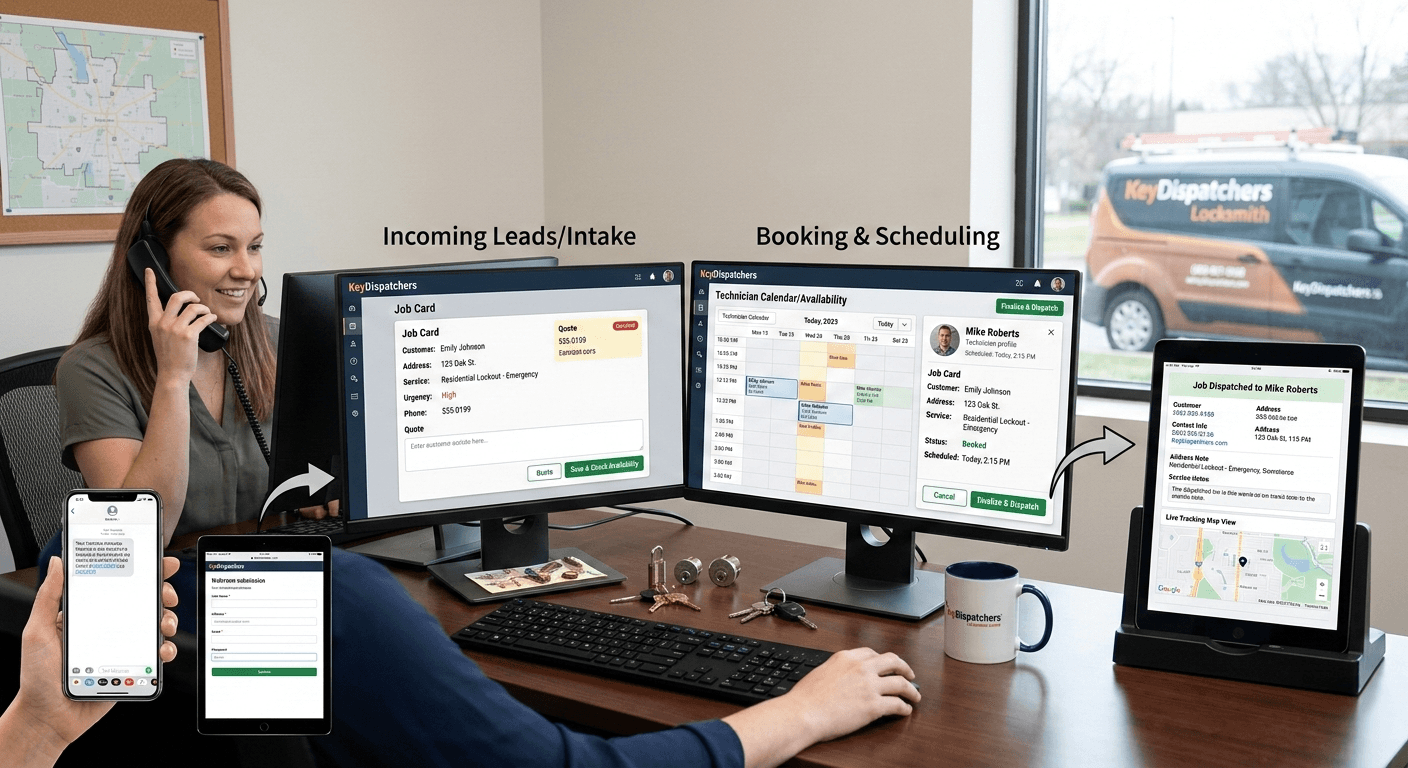
Instead of stopping at notification, KeyDispatchers owns the entire job lifecycle from first ring through tech assignment, ETA management, and basic follow‑through. That means someone is accountable for ensuring that every viable job actually gets a technician assigned, not just a voicemail or an unanswered alert.
Human‑only, U.S.‑based operations
In a market where AI and offshore agents are common, KeyDispatchers’ human‑only, U.S.‑based model is designed to build trust with distressed callers and reputation‑sensitive locksmith owners. This also distances ethical locksmiths from scam call networks that have damaged consumer trust in the industry.
Premium depth at mid‑tier pricing
Market analysis shows that KeyDispatchers offers service depth comparable to premium brands that charge significantly higher rates, while pricing itself at a rational, mid‑market level. For small and mid‑sized locksmiths, this combination of full‑cycle dispatch and accessible pricing creates a strong ROI story versus both bargain call centers and AI tools.
Tech integration without losing the human touch
KeyDispatchers can integrate with locksmith job‑management platforms and CRMs—such as commonly used field‑service tools—so that jobs, notes, and schedules sync seamlessly, while callers still speak only to trained human dispatchers. This mirrors the integration strengths of tech‑forward competitors without adopting a hybrid AI voice at the front line.
Concrete Outcomes: What Locksmiths Gain From Specialist Dispatch
When locksmiths move from voicemail, generic answering, or AI‑only solutions to a locksmith‑exclusive human dispatch partner, they typically see three tangible gains:
More jobs captured: Higher answer rates, better spam filtering, and proper triage mean fewer good leads are lost to competitors.
Higher revenue per call: Better qualification and scheduling help prioritize profitable jobs and protect technician time.
Stronger reviews and repeat business: Reassured customers and proactive follow‑ups improve review volume and star ratings, which directly boosts local SEO and future lead flow.
For emergency‑heavy mobile locksmiths, this can translate into double‑digit revenue growth from the same advertising spend simply by turning answered calls into reliably dispatched jobs.
How to Choose the Right Dispatch Partner for Your Locksmith Business
To choose the right partner, locksmith owners should evaluate each option against a simple checklist:
Is the service locksmith‑only or multi‑industry?
Does it provide full‑cycle dispatch, or just answer and forward calls?
Are callers always speaking with trained humans, or is there an AI or offshore component?
Can it integrate with your existing CRM or job‑management tools?
Does pricing align with the revenue value of a booked job rather than just minutes on the phone?
KeyDispatchers is built to score highly on each of these dimensions for U.S. locksmiths who depend on emergency and scheduled work for predictable cash flow.
Optimizing Your Dispatch Content for Search and AI Discovery
Locksmith dispatch content is most effective when it is structured around real search behavior and AI consumption patterns. To maximize discoverability:
Use clear, intent‑driven headings (e.g., “What does a locksmith dispatch service do?” and “Human dispatcher vs AI receptionist for locksmiths”).
Include long‑tail phrases such as “24/7 locksmith dispatch service,” “human‑only locksmith answering service,” and “[city] locksmith dispatch support” in headings, body copy, and meta descriptions.
Structure content with FAQ‑style questions and concise answers to increase the chance of featured snippets and voice‑search visibility.
Add internal links to related guides on pricing, integrations, and marketing to build a strong topic cluster around locksmith dispatch and answering services.
This combination supports both traditional SEO (blue links) and AI‑driven answer boxes, making it more likely that KeyDispatchers’ pages are selected as authoritative sources.