Onboarding/Operations
What Happens During the Free 3-Day Trial With KeyDispatchers
Learn exactly what happens during the KeyDispatchers free 3-day trial, from setup and scripting to live call handling, Workiz workflow testing, and go-live review.
Onboarding/Operations
Learn exactly what happens during the KeyDispatchers free 3-day trial, from setup and scripting to live call handling, Workiz workflow testing, and go-live review.
Meta title: What Happens During the Free 3-Day Trial With KeyDispatchers
Meta description: Learn exactly what happens during the KeyDispatchers free 3-day trial, from setup and scripting to live call handling, Workiz workflow testing, and go-live review.
Suggested URL slug: /blog/free-3-day-trial-locksmith-dispatch
Category: Onboarding / Operations
When a locksmith business looks at outsourced dispatch, the biggest question usually is not “Do we need help?” It is “What happens after we say yes?”
That is why the free 3-day trial matters.
Instead of locking you into a long process or asking you to commit before you see real results, the trial gives you a chance to test KeyDispatchers in a live environment with your own calls, your own workflow, and your own brand voice. KeyDispatchers is already positioned as a 24/7 human-only dispatch service for locksmith businesses, with full-cycle support and Workiz-based workflows depending on plan level.
For small and mid-sized locksmith shops, that kind of trial removes most of the risk. You are not guessing whether the service will fit your business. You are seeing it work in real time.
KeyDispatchers is not trying to be a generic call center. The brand is built around locksmith-only call handling, trained operators, Workiz integration, and live human dispatch support.
That means the trial is not just about answering a few calls. It is about testing whether the service actually feels like an extension of your shop.
During the 3-day trial, the goal is to answer a few important questions:
Do the operators sound professional and helpful?
Are calls being answered quickly enough?
Are leads being qualified properly?
Are jobs being booked the right way?
Does the Workiz flow make sense for your team?
Does the service reduce pressure on the owner, office staff, or technicians?
If the answer is yes, the next step is simple. If the answer is no, you have learned that without making a long commitment.
The first part of the trial is all about setup.
Before calls are routed live, KeyDispatchers needs the basics that shape how your dispatch flow works. Since the service operates through Workiz for dispatching, job tracking, and reporting, this setup stage is essential rather than optional.
This usually includes:
Your business name and preferred greeting
Your main services, such as lockouts, rekeys, car key copy, ignition work, commercial calls, or smart locks
Your service areas and zip rules
Your dispatch hours and any special after-hours rules
Your minimum pricing or approved quote language
Technician availability and routing preferences
Escalation rules for urgent or unusual calls
Workiz access and workflow structure
This stage is also where the script starts taking shape. KeyDispatchers publicly promises human-only service and locksmith-focused operators, so the trial setup should make sure that promise sounds right when a customer calls your line.
Once the core business details are collected, the next step is building your call flow.
This is where KeyDispatchers becomes more than just an answering layer. Depending on plan level, the service can handle live answering, lead intake, lead forwarding, full customer intake, dispatching, scheduling, routing, notes, technician communication, quotes, and follow-up workflows.
The trial call flow should answer questions like:
What should happen on a routine residential lockout?
What should happen on an automotive key call?
What should happen when a caller is outside your service area?
What should happen when pricing is unclear?
What should happen if the customer wants a same-minute ETA?
What should happen if the tech is busy, unavailable, or needs owner approval?
Getting this part right matters because small locksmith shops do not need “more process” for the sake of process. They need a clear and repeatable way to stop losing calls while keeping control over how jobs are booked.
By the second phase of the trial, the important shift happens: real calls start coming in.
This is the moment where theory disappears. Customers ask real questions, operators respond in real time, and your workflow gets tested under normal conditions.
Because KeyDispatchers is positioned around 24/7 live human call answering, the trial should prove that your customers are reaching a real person rather than voicemail or a generic answering experience.
During the live portion of the trial, the team should be watching for a few practical things:
Are calls answered quickly and calmly?
Are callers being qualified correctly?
Are the right details being captured?
Are jobs being forwarded or booked without confusion?
Are Workiz notes clean and useful?
Are technicians getting the information they need?
This is also where small issues surface, which is a good thing.
Maybe one pricing phrase needs to change. Maybe a service area needs to be narrowed. Maybe an auto-key call type needs a different tag inside Workiz. Those are exactly the kinds of adjustments the free trial is supposed to uncover before anything becomes long term.
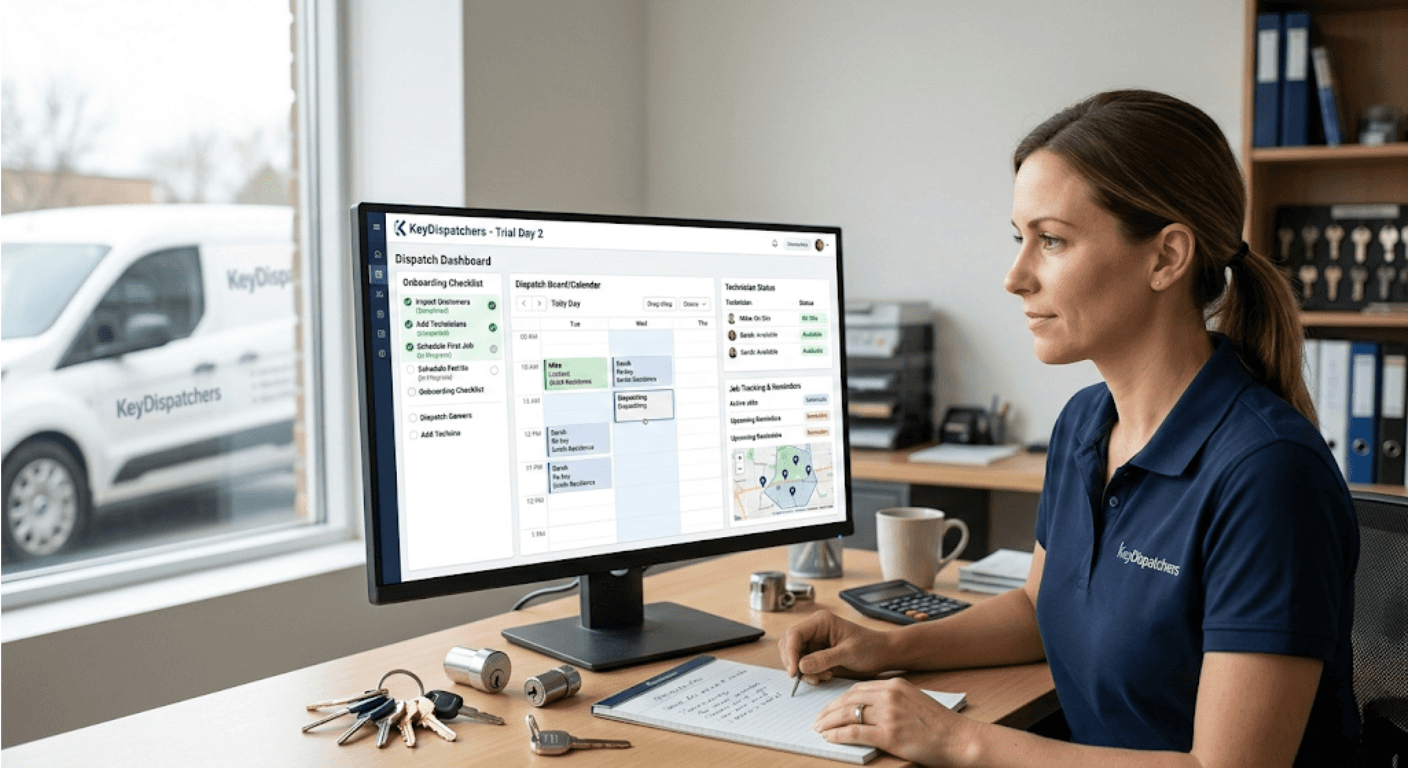
One of the strongest parts of your setup is that KeyDispatchers operates through Workiz, and the site already frames Workiz as required for seamless dispatching, job tracking, and reporting.
That means the 3-day trial is not only about call quality. It is also about operational clarity.
Inside the trial, Workiz should be tested for:
Job creation
Notes structure
Tagging
Status flow
Technician assignment
Routing logic
Follow-up handling
Reporting visibility
This matters because a dispatch service can sound great on the phone and still create internal chaos if the system side is sloppy. A good trial proves both sides: customer-facing professionalism and back-end operational cleanliness.
By the third day, you should have enough real activity to review the service honestly.
This review should not be based on vague feelings alone. It should focus on what actually happened during the live trial.
A useful review usually looks at:
How many calls were answered
How many leads were captured
How many jobs were booked or forwarded
Whether callers were handled professionally
Whether Workiz entries were accurate
Whether any calls exposed script gaps or routing issues
Whether the owner or team felt less overloaded
This step is especially important for SMB locksmiths because the right dispatch partner should create relief almost immediately. If the owner still feels chained to the phone after three days, something is wrong. If the shop suddenly feels more organized and less reactive, the value becomes obvious.
A free trial should not exist just to “sample” the service. It should prove whether the model works for your business.
For KeyDispatchers, the trial should prove four things:
A real human is answering your locksmith calls consistently.
Your business can run with cleaner intake and less missed-call pressure.
Your Workiz workflow can support smoother dispatch and reporting.
The service feels like a practical fit before any bigger commitment is made.
That is what makes the offer strong. Your site already emphasizes flexible pricing, unlimited calls and minutes, no setup fee, and no-contract plans that can be started, paused, or upgraded anytime. The free 3-day trial fits that same low-friction promise.
The trial is especially valuable for:
Solo locksmith owners who miss calls while on jobs
Small teams that only answer well during business hours
Growing shops that need help with intake and dispatching
Workiz users who want cleaner booking and reporting
Multi-location locksmiths who need location-based call handling
Your pricing page already makes it clear that the service is structured for different growth stages, from lighter answering support in Starter to full-cycle dispatch and deeper reporting in Starter+ and Pro. The trial gives each type of shop a low-risk way to see where they fit.
At the end of the trial, the next step should feel simple.
You review what worked, what needs adjustment, and which plan level matches your real call flow. KeyDispatchers already offers a tiered structure, including Starter for live answering and qualification, Starter+ for fuller dispatch support, and Pro for dedicated-agent service, call audits, and custom SLA options.
If the trial worked, you continue with the right plan. If you need a few adjustments first, you tighten the script, routing, or Workiz workflow. And if it is not the right fit, you walk away with clarity instead of guesswork.
That is exactly how a good trial should work.
The best way to understand outsourced locksmith dispatch is not by reading promises. It is by seeing how your own calls are handled over a few real days.
If your shop is missing calls, juggling dispatch manually, or trying to grow without hiring more office staff, the free 3-day trial is the easiest place to start. You get to test the people, the process, and the Workiz workflow before making any real commitment.
Start your free 3-day trial and see how KeyDispatchers handles your calls, your bookings, and your dispatch flow in the real world.