Operations/Onboarding
How KeyDispatchers Books a Job From First Call to Final Dispatch
See how KeyDispatchers handles a locksmith job from the first inbound call to qualification, Workiz entry, routing, scheduling, and final dispatch.
Operations/Onboarding
See how KeyDispatchers handles a locksmith job from the first inbound call to qualification, Workiz entry, routing, scheduling, and final dispatch.
When a locksmith call comes in, the real question is not just whether someone answers. It is whether that call turns into a clean, bookable job without confusion, delay, or lost details.
That is the gap KeyDispatchers is built to solve. The site positions the service around 24/7 human-only locksmith dispatch, full-cycle booking, scheduling, Workiz integration, and location-based routing depending on the plan.
For a small or mid-sized locksmith business, that matters because the phone call is often the moment revenue is either captured or lost. A messy intake process can create bad quotes, missed jobs, confused techs, and wasted time. A clean dispatch flow does the opposite.
The process starts with a real human answering the phone.
KeyDispatchers publicly presents itself as a 24/7 human-only dispatch service for locksmith businesses, with live human call answering included across plans. That means the customer does not hit voicemail first and does not get dropped into a generic answering flow.
This first moment matters because the caller is usually looking for fast help, clear answers, and confidence that they reached a real locksmith business.
/
Once the call is answered, the next step is qualification.
On the Starter plan, KeyDispatchers already includes lead intake and qualification. On Starter+ and Pro, that goes further into full customer intake and dispatching.
At this stage, the operator is usually confirming:
The customer’s name
Callback number
Service address
Type of locksmith issue
Whether the call is urgent
Whether the caller is ready to book now
The point is to quickly separate real job opportunities from incomplete, out-of-area, or low-fit calls without making the customer feel interrogated.
Not all locksmith jobs should move through the same path.
KeyDispatchers markets dispatching solutions specifically for locksmith work, including emergency call handling, full-cycle dispatch and scheduling, lead qualification, and Workiz CRM integration. Because of that, the operator should identify what kind of job this is before anything is promised.
That may include:
House lockout
Car lockout
Rekey
Car key replacement
Ignition problem
Commercial service
Smart-lock issue
Appointment request
This keeps the booking process accurate from the start and helps match the job to the right script, pricing rules, and dispatch path.
Once the job type is clear, the next question is location.
Your pricing page says KeyDispatchers supports location-based job routing and can work with multi-location locksmith businesses by routing calls by service area and assigning techs by location. That means the dispatcher should check whether the address fits the client’s approved territory before booking the job.
This step helps avoid two common problems:
Booking jobs too far outside the normal service zone
Sending the wrong technician to the wrong area
If the service area rules were set up correctly during onboarding, this step should feel quick and routine.
Once the call is qualified and the location fits, the dispatcher moves into pricing language.
The Pro plan specifically includes providing quotes, and higher-tier plans include full customer intake and dispatching. That means pricing communication should follow the locksmith company’s approved rules, not guesswork.
In practice, that may mean:
Giving a starting rate
Explaining a service-call minimum
Using a price range
Explaining that final price depends on vehicle, lock type, or job complexity
The goal is not to overpromise. The goal is to sound clear, professional, and consistent.
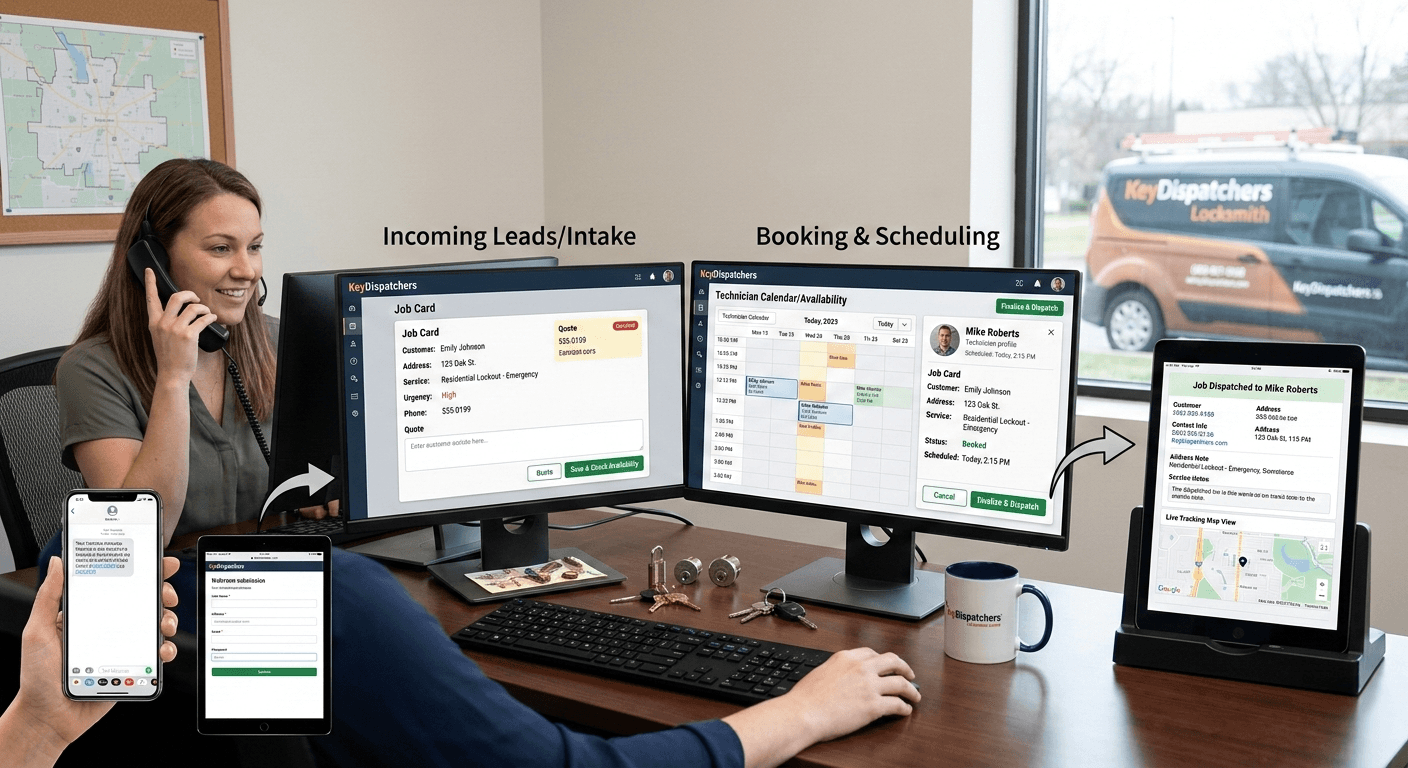
After the customer is qualified and agrees to move forward, the job goes into Workiz.
KeyDispatchers says it operates exclusively through Workiz to ensure seamless dispatching, job tracking, and reporting. Starter+ includes Workiz platform integration, and Pro includes full Workiz integration support plus free migration help.
At this point, the dispatcher typically records:
Customer details
Address
Service type
Notes from the call
Pricing notes
Urgency level
Routing or tech assignment details
This is where the process stops being “someone took a message” and becomes a real operating workflow.
Once the job is in the system, the next question is what should happen next.
Starter is more forwarding-focused, while Starter+ and Pro are built for fuller dispatch ownership, including job scheduling, follow-ups, technician communication, and full-cycle dispatch and booking. So the exact next step depends on the client’s plan and workflow.
That may mean:
Forwarding the lead to the locksmith team
Scheduling the appointment
Dispatching the on-call technician
Assigning the job by zone
Escalating to owner approval
Passing the job to a dedicated brand-only agent on Pro
This step is where your service starts to feel like an off-site office team rather than just a phone-answering vendor.
For plans with deeper dispatch support, the job does not stop at booking.
The Pro plan explicitly includes communicating with technicians, and Starter+ includes full customer intake, dispatching, and job scheduling. That means KeyDispatchers can help close the gap between customer intake and field execution.
At this stage, the right tech should receive:
The job type
The address
The customer callback
Any notes that affect the visit
Any known pricing context
Any urgency or access details
This is one of the biggest ways clean dispatch improves the day-to-day operation of a locksmith business.
A job is not truly booked well if nobody can tell what happened after the call.
Because KeyDispatchers uses Workiz as the central workflow layer, status updates, notes, and job progress can stay tied to the same operating record. On higher plans, CRM notes and updates, full reports, and call audits are already part of the promise.
That gives the locksmith business a cleaner view of:
What was promised
Who was assigned
What stage the job is in
What follow-up may still be needed
For small shops especially, that reduces the usual chaos of scattered texts, handwritten notes, and forgotten callbacks.
A strong booking process should create visibility, not just activity.
Your site already positions KeyDispatchers around deep reporting, full reports, call audits, and Workiz-based tracking. Because of that, the business should be able to review how calls are turning into jobs and where the workflow can be improved.
That means the booking process does not just help in the moment. It also creates a record the owner can actually use to improve scripts, routing, staffing, and conversion over time.
At a simple level, KeyDispatchers is selling 24/7 live locksmith call coverage. At a more operational level, it is selling a cleaner path from inbound call to booked and routed job.
That is an important difference.
A generic answering service may stop at “someone called.” Your current offer goes much further: qualified intake, dispatching, scheduling, Workiz-based workflow, technician coordination, reporting, and flexible plans ranging from simple call handling to full-cycle brand-dedicated dispatch.
That is exactly what makes the service easier to understand for SMB locksmiths. It is not abstract. It is a step-by-step way to stop missed calls from turning into missed revenue.
If your locksmith business is still relying on missed calls, handwritten notes, or owner-managed dispatch while out in the field, the problem is usually not demand. It is workflow.
KeyDispatchers is built to tighten that workflow from the first ring to the final handoff inside Workiz.
Start the free 3-day trial and see how KeyDispatchers books real jobs inside your actual workflow before making any long-term commitment.