Operations/Onboarding
How After-Hours Locksmith Calls Are Handled Step by Step
See how KeyDispatchers handles after-hours locksmith calls step by step, from the first ring to booking, dispatch, Workiz updates, and customer follow-up.
Operations/Onboarding
See how KeyDispatchers handles after-hours locksmith calls step by step, from the first ring to booking, dispatch, Workiz updates, and customer follow-up.
Yes — this should be the next article, because after-hours coverage is one of the clearest ways to show that KeyDispatchers is a real operational partner, not just an answering service. Your site already positions the brand around 24/7 human-only locksmith dispatch, Workiz-based workflows, and full-cycle booking support on higher plans, while your own research content argues that most locksmith demand happens outside normal business hours.
Meta title: How After-Hours Locksmith Calls Are Handled Step by Step
Meta description: See how KeyDispatchers handles after-hours locksmith calls step by step, from the first ring to booking, dispatch, Workiz updates, and customer follow-up.
Suggested URL slug: /blog/how-after-hours-locksmith-calls-are-handled
Category: Operations / Onboarding
After-hours locksmith calls are where a lot of revenue is won or lost.
A customer calling at 9:30 PM is usually not browsing casually. They are locked out, stranded, stressed, price-conscious, and ready to book with the first company that sounds legitimate and helpful. Your own research content makes that point clearly: 67% of locksmith calls come outside traditional business hours, and missed calls in this category often turn into immediate lost revenue.
That is exactly why after-hours handling needs to be a system, not a scramble.
At KeyDispatchers, the goal of after-hours call handling is simple: a real person answers, the caller gets clear next steps, the job is qualified properly, the right details go into the system, and the locksmith business stays in control of pricing, routing, and booking rules through Workiz-based workflows.
For many locksmith shops, after-hours demand is not a side category. It is the highest-stakes part of the business.
Your research articles already frame the phone call as the main revenue event for emergency locksmith work, especially after hours, when callers are less patient and more likely to move on immediately if nobody answers. Those same articles also argue that weekend and evening calls are often more valuable than daytime calls because urgency is higher and the customer is usually ready to act right away.
That is why a good after-hours process cannot rely on “call me back when you wake up” logic. It has to work in real time.
The first step is the most important one: someone actually answers.
KeyDispatchers publicly positions itself as a 24/7 human-only dispatch service for locksmith businesses, not an AI-first or voicemail-first operation. That matters because your own missed-call research argues that locksmith customers calling after hours are usually in an urgent state and often call the next company within seconds if they hit voicemail.
In practical terms, this first moment sets the tone for everything else.
The caller should hear a calm, confident greeting that sounds like a real business, not a generic overflow line. At night, that matters even more because trust is fragile. The caller is already wondering whether the company is real, whether the price will be fair, and whether help is actually coming.
Not every after-hours locksmith call should be handled the same way.
The next step is fast qualification. The operator needs to understand what kind of help the customer is asking for, how urgent it is, and whether it fits the shop’s service rules.
That usually means identifying:
Residential lockout
Automotive lockout
Car key issue
Commercial lockout
Rekey request
Broken key
Ignition issue
Smart-lock issue
Security-related urgent call
This step matters because the pricing language, the technician match, and even the response expectations may change depending on the job type. Your pricing page already shows that KeyDispatchers supports full customer intake, dispatching, scheduling, quotes, and technician communication on higher plans, which makes this kind of qualification part of the real workflow, not just a note-taking exercise.
Once the call type is clear, the next job is location.
The dispatcher confirms where the caller is and checks whether that address is inside the locksmith company’s approved coverage area. That is especially important after hours, because many locksmith shops do not serve every neighborhood, county, or outlying area equally at night.
This is where onboarding work becomes visible. If pricing rules, service areas, and routing preferences were set up properly ahead of time, the dispatcher should already know:
Whether the address is in range
Whether it needs approval
Which technician or zone normally covers it
Whether special after-hours rules apply
Your Starter+ plan already references location-based job routing and Workiz integration, so the site is clearly presenting geography-aware dispatch as part of the service model.
After-hours calls are high-stress, but that does not mean pricing should sound vague or evasive.
The operator should use the locksmith company’s approved pricing language, based on whatever was set during onboarding. That may mean a starting price, a service-call minimum, a range, or a clear explanation that final cost depends on the lock type, vehicle, or job complexity.
The important thing is consistency.
Your site already states that quotes can be handled on qualifying plans, but that only works if the dispatcher is following approved client rules instead of improvising. A good after-hours process does not promise what the technician cannot deliver, and it does not leave the customer feeling like nobody can give them even basic direction.
At this point, the customer should know three things:
Whether the business can help
What the next step is
How pricing will be handled
Once the call is qualified and the customer wants service, the job should move into the system immediately.
This is one of the clearest operational differences between a real dispatch workflow and a simple answering service. Workiz is already positioned on your site as a central part of the KeyDispatchers workflow, especially for dispatching, tracking, and reporting.
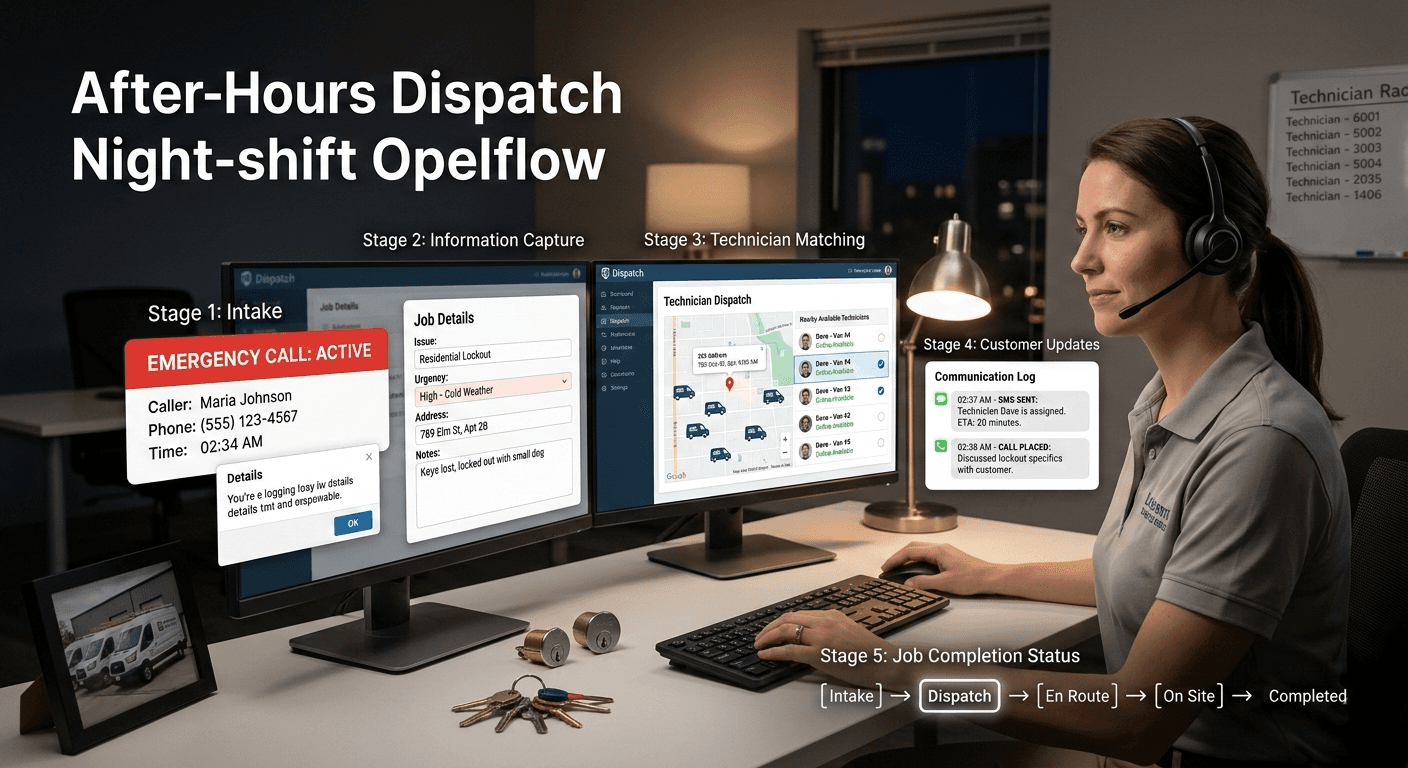
At this stage, the dispatcher typically logs:
Customer name
Callback number
Address
Service type
Urgency
Pricing notes
Special instructions
Any access or safety details
The point is not just recordkeeping. The point is to make sure the right technician sees the right information without the owner having to reconstruct the call later.
After the job is in the system, the next step is dispatch.
Workiz is marketed for locksmith scheduling and dispatch workflows, and your pricing page already says KeyDispatchers can handle full intake, dispatching, scheduling, routing, and technician communication on the more advanced plans. That means the after-hours process should include a clear action path rather than “someone will check this in the morning.”
Depending on the business setup, that next action might be:
Dispatching the on-call tech immediately
Assigning the call by zone
Escalating to owner approval
Routing to a specialty technician
Scheduling the call for the earliest next slot if it is not truly urgent
The key is that the decision happens based on defined rules, not guesswork.
After-hours callers do not just want a job entered into a system. They want reassurance.
Once the job is booked or routed, the customer should be told exactly what happens next. That may include the technician’s ETA, a pending confirmation, or a clear explanation that someone is being dispatched now.
This part sounds simple, but it matters a lot. Your research articles repeatedly frame locksmith calls as urgency-driven, trust-sensitive interactions where fast, clear communication shapes conversion and customer confidence. After hours, silence feels suspicious. Clarity feels professional.
A strong dispatcher update usually covers:
Confirmation that the request was received
What kind of help is being sent
Whether the technician is on the way or being assigned
What the customer should expect next
The customer only sees one side of after-hours dispatch. The locksmith business sees the other side.
Behind the scenes, the dispatcher may also be messaging or updating the technician, confirming job details, clarifying notes, or passing along special instructions. Your pricing page explicitly includes technician communication and full-cycle dispatch support on the higher plan tiers.
This is where a lot of after-hours friction gets removed.
Instead of an owner waking up to missed texts, partial voicemails, and handwritten details, the job already exists in the system with cleaner context. The technician gets a more organized handoff, and the business has a clearer audit trail of what happened.
After-hours work gets messy fast when nobody tracks what changed.
That is why the job should continue to be updated inside the workflow as new information comes in. Because Workiz is already part of the service model for dispatching and reporting, it gives KeyDispatchers a place to keep those updates organized.
That may include:
ETA changes
Reassigned technician
Customer callbacks
Access notes
Pricing clarifications
Completion-related updates for the morning team
This matters for small and mid-sized locksmith businesses because they usually do not have layers of admin staff cleaning up the night shift later. If the after-hours workflow is not documented properly, the morning starts with confusion.
A strong after-hours process should not disappear into the night. It should leave a usable record.
Your site already highlights Workiz integration and deep reporting, and the Pro plan specifically mentions full reports and call audits. That means after-hours handling should feed into visibility later, not just action in the moment.
The business should be able to review:
How many after-hours calls came in
How many became booked jobs
What service types were most common
Whether routing worked correctly
Whether scripts or pricing language need refinement
That review loop is how after-hours coverage becomes an operating advantage instead of just a staffing patch.
From the outside, a great after-hours dispatch flow feels simple.
The customer calls. A real person answers. The caller gets clear questions, clear pricing language, and a clear next step. The job goes into Workiz. The right technician gets the right information. The business wakes up with order instead of chaos.
From the inside, that simple experience only happens because the system behind it is tight.
That is the value of a proper onboarding process, documented pricing rules, mapped service areas, script alignment, and human dispatchers who understand locksmith call handling. It turns the most stressful hours of the day into a repeatable process.
After-hours locksmith work should not depend on luck, voicemail, or whoever happens to be awake.
If your business gets most of its highest-urgency calls at night, on weekends, or outside office hours, the process behind those calls matters just as much as the technician who shows up. Your site already positions KeyDispatchers around 24/7 human-only handling, Workiz-based workflows, and flexible plan tiers that can support everything from live answering to full-cycle dispatch.
Start the free 3-day trial and see how after-hours locksmith calls are handled inside a real human dispatch workflow before making any longer commitment.