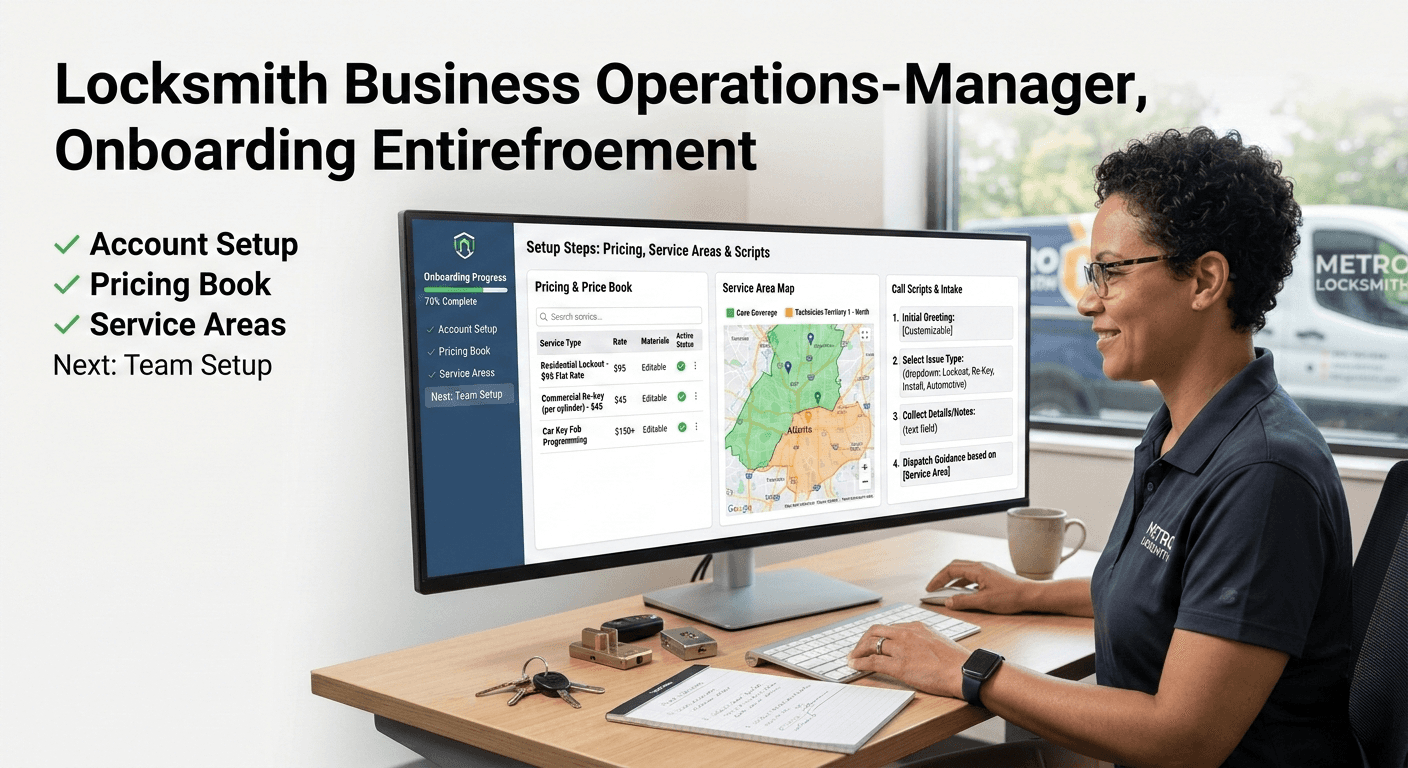
When a locksmith business starts using an outsourced dispatch service, three setup areas matter more than almost anything else: pricing, service areas, and scripts.
If those three are not clear, even a good dispatcher can sound uncertain. Jobs get quoted inconsistently. Calls come in from places you do not want to serve. Customers hear mixed messages. Technicians arrive with the wrong expectations.
That is why onboarding should not just be about forwarding the phone. It should be about building the rules behind the phone.
At KeyDispatchers, that setup matters because the service is positioned as more than simple call answering. The site promises human-only locksmith dispatch, full customer intake, job scheduling, location-based job routing, Workiz integration, quotes, technician communication, and full-cycle booking support depending on plan level.
Why these three setup areas matter
A locksmith customer usually calls because they need help now, not because they want to study your business process. That means the person answering the phone has to sound clear, calm, and confident from the first few seconds.
That confidence usually comes from having the right rules in place ahead of time.
Pricing rules protect you from sloppy quoting. Service-area rules protect you from wasting time on jobs outside your ideal range. Scripts protect the consistency of your brand voice.
When all three are aligned, the call feels smooth. The customer gets a straight answer. The dispatcher knows what to do next. The tech gets cleaner information. The owner does less cleanup later.
How pricing is set up during onboarding
Pricing is one of the biggest pain points in locksmith call handling because every owner wants control, but customers still expect clarity on the phone.
During onboarding, the goal is not to turn dispatchers into final decision-makers on every locksmith job. The goal is to define what they can say, what they cannot say, and where owner or technician approval is needed.
That setup usually starts with a simple pricing structure:
What is your service-call minimum
What services can be quoted with a starting range
What services must be described as “final price depends on the technician”
What after-hours, weekend, or emergency language should be used
What types of calls should never receive a hard quote on the phone
This approach fits your current service model because the site already says KeyDispatchers can provide quotes and handle full-cycle booking on higher plans, but that only works well if quoting rules are documented in advance.
For many locksmith businesses, the smartest setup is not “quote everything.” It is “quote what is predictable, qualify what is not, and never let the customer feel brushed off.”
That gives dispatchers enough structure to sound helpful without creating pricing mistakes that hurt trust later.
How service areas are set up
Service-area setup is just as important as pricing, especially for locksmith shops trying to stay profitable.
A job may sound great on the phone, but if it is too far away, outside your normal zone, or in an area you only cover during certain hours, the wrong booking can waste time, fuel, and technician availability.
That is why service-area setup during onboarding should be specific.
Instead of saying “we serve the whole city,” the dispatcher should know things like:
Which cities, neighborhoods, zip codes, or counties are in range
Which areas are handled only during business hours
Which areas require approval before dispatch
Which areas should be referred out or declined
Whether different technicians cover different zones
This matches the way your offer is already framed, because Starter+ specifically includes location-based job routing and Workiz platform integration, while Pro adds full-cycle dispatch depth and broader workflow control.
Workiz also supports scheduling and dispatch workflows for locksmith businesses, which makes it a logical place to organize service zones, assignments, and routing rules during onboarding.
When this part is done right, the dispatcher is not guessing. They know whether a call is bookable, who should get it, and whether any approval is needed before promising service.
How scripts are built
A script should not make your business sound robotic. It should make your business sound consistent.
That is an important difference.
Most locksmith owners do not want a dispatcher reading from a stiff paragraph. They want a trained operator who sounds natural, knows what to ask, and handles common call types the same way every time.
That is especially important for your brand, because the site now leans into language like human-only dispatch, helpful humans, locksmith-industry-trained operators, and under-30-second response positioning.
During onboarding, script setup usually covers:
How the business name is answered
What tone should be used
How to ask service questions without sounding scripted
How pricing language should be presented
How to explain ETA expectations
How to handle callers outside the service area
How to respond when the caller is frustrated, rushed, or price-shopping
This part matters because locksmith calls are not all the same. A residential lockout, a commercial rekey inquiry, and an auto-key call all need different phrasing, even if the brand voice stays the same.
The best scripts are usually built more like guided call flows than word-for-word speeches. That gives operators structure without making them sound unnatural.
How all three come together inside Workiz
This is where onboarding becomes operational instead of theoretical.
Once pricing rules, service-area rules, and scripts are set, they need to connect to the actual dispatch workflow. Since KeyDispatchers uses Workiz as a core part of the operating model on qualifying plans, that means these rules should feed directly into how jobs are created, tagged, routed, and updated.
In practice, that may look like this:
A caller asks for help with a home lockout.
The dispatcher checks whether the address is in your approved zone.
The dispatcher follows the approved script for that call type.
The dispatcher uses your approved pricing language.
The job is created or updated in Workiz.
The right technician or workflow gets the job next.
That kind of flow is exactly why Workiz is useful for locksmith businesses. The platform is built around dispatching, scheduling, job management, and reporting, so it gives your onboarding rules a real place to live.
What a good setup feels like
When pricing, service areas, and scripts are properly set up, the owner feels less friction almost immediately.
Calls stop feeling random. Dispatchers sound more prepared. Customers get cleaner answers. Fewer bad-fit jobs slip through. Notes make more sense. Techs are less likely to call back asking what was promised.
That is the real goal of onboarding. Not complexity. Not paperwork. Just clarity.
For small and mid-sized locksmith businesses, this matters even more because there usually is not a big office team catching mistakes in the background. The process has to work cleanly from the first call.
The best onboarding setups are not the most complicated ones. They are the ones that give dispatchers clear rules, give customers better answers, and give locksmith owners fewer headaches.
That is exactly why pricing rules, service-area rules, and scripts should be built before the service goes fully live.
If your shop is thinking about outsourced dispatch, the right first step is not a long contract. It is a simple setup, a clear workflow, and a free 3-day trial that shows how everything works in the real world. Your site already positions KeyDispatchers around no-contract flexibility, Workiz-based workflows, and plan tiers that scale from lighter support to full-cycle dispatch.
Start the free 3-day trial and see how KeyDispatchers sets up your pricing logic, service zones, and scripts before you make any long-term decision.