Auto Key Copy: Why Certified Locksmiths Deliver Dealership-Quality Key Duplication at 30–50% Lower Cost
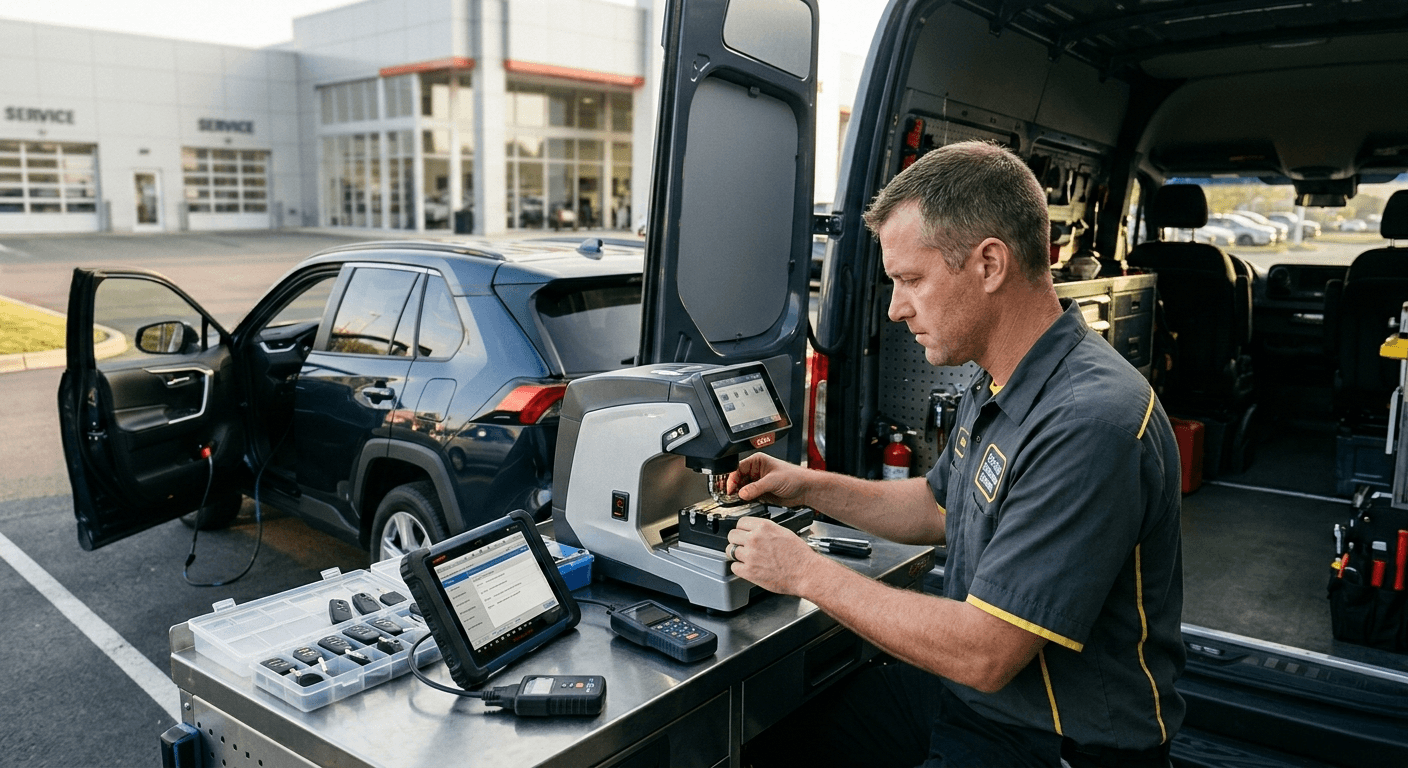
A split-frame image: on the left, a modern transponder car key being cut by a professional mobile locksmith at a customer's vehicle; on the right, a dealership service counter with a visible price tag showing a higher cost. Clean, professional, editorial photography style with cool blue tones.
24/7 LIVE DISPATCHING
Every missed call is a missed job.
Our human dispatchers answer for you around the clock.
Introduction: The Hidden Cost Gap American Drivers Are Missing
A Consumer Reports field test found that a certified locksmith completed a full key fob replacement — including cutting and programming — for $125, compared to a $198 dealer quote for the identical service. That represents a 37% savings on a functionally identical outcome.[1]
This is not an isolated case. Across the $2.9 billion U.S. locksmith services industry, certified automotive locksmiths routinely deliver transponder key programming and smart key duplication at 30–50% lower cost than dealerships, with dramatically faster turnaround times. Yet the majority of American consumers default to their dealership when they need an auto key copy, driven by brand familiarity bias and a persistent misperception that dealership pricing reflects superior quality.[1]
For locksmith SMBs — particularly those operating in high-demand East Coast markets — understanding the research behind this pricing gap reveals a significant, quantifiable revenue opportunity. The data tells a clear story: the consumer migration away from dealerships is accelerating, and the businesses positioned to capture that demand stand to benefit measurably.
The Scale of Demand: Why Auto Key Duplication Is a Growth Market
The U.S. locksmith services industry generated $2.9 billion in revenue in 2025, with 29,304 businesses operating nationally — a 2.8% year-over-year increase in business count. The global automotive locksmith services market was valued at $4.2 billion in 2024 and is projected to reach $7.8 billion by 2033, growing at a compound annual growth rate of 6.8%.[1]
Several structural factors are compounding this demand:
Motor vehicle maintenance and repair costs rose 15% year-over-year as of August 2025 — the largest single-month increase on record
43% of automotive consumers are now willing to switch service brands for a lower price
||| For locksmith businesses fielding high volumes of auto key copy calls, every missed inquiry represents lost revenue. A structured call answering system ensures no opportunity falls through the cracks — even during peak after-hours demand. Explore how KeyDispatchers structures emergency call coverage → |||
The Technological Reality: Why Locksmith Key Programming Equals Dealership Quality
Modern automotive keys are no longer simple mechanical devices. Since the introduction of the first transponder key in 1995, vehicles have increasingly relied on electronic immobilizer systems requiring a key's embedded microchip to communicate with the vehicle's Engine Control Unit (ECU) before the engine starts.[1]
The transponder key segment dominates the automotive key market, accounting for approximately 91.8% of market share by product type. The global automotive key market was valued at $6.64 billion in 2024, projected to reach $14.94 billion by 2034 at a CAGR of 8%.[1]
The Security Equivalence Evidence
A landmark peer-reviewed study by economists Jan C. van Ours and Ben Vollaard at Tilburg University, published in the Economic Journal (2016), found that mandatory application of the electronic engine immobilizer reduced the overall rate of car theft by approximately 40–50% in the Netherlands between 1995 and 2008. Vehicle theft declined 70% in the Netherlands and up to 80% in Great Britain over this period.[4][5][1]
The critical insight from this research: the security value of transponder-based keys is embedded in the chip and the vehicle's ECU programming protocol — not in whether the key was programmed at a dealership or by a certified locksmith. Both service channels use equivalent programming interfaces to sync transponder codes with the vehicle's immobilizer system.[1]
According to NXP, a leading supplier of vehicle access and immobilizer technology, such systems have reduced car theft by more than 90% since their introduction. The National Insurance Crime Bureau (NICB) confirms that U.S. vehicle thefts fell 17% in 2024 to 850,708 — below one million for the first time since 2021, and the largest annual decrease in 40 years.[6][1]
The transponder chip's security handshake with the vehicle's ECU is a binary pass/fail: either the key's serial number matches the immobilizer's stored code, or it does not. Modern key programming devices used by certified locksmiths communicate directly with the vehicle's onboard computer to create new keys matching the vehicle's unique cryptographic code — the same interface used by dealership equipment.[1]
The Associated Locksmiths of America (ALOA) offers a Certified Automotive Locksmith (CAL) designation as the entry-level certification for automotive specialists, and a Certified Master Automotive Locksmith (CMAL) as the advanced credential. These certifications evaluate proficiency across transponder key programming, smart key systems, and electronic access control.[1]
Comparative Analysis: Dealership vs. Certified Locksmith Key Replacement
The pricing and service differences between dealerships and certified automotive locksmiths are well documented across multiple industry research sources.
Factor
Dealership
Certified Automotive Locksmith
Research Source
Transponder key cost
$125–$250+
$75–$150[1]
J.D. Power; Consumer Reports
Smart key / fob cost
$200–$600+
$150–$300[1]
Edmunds; ALOA data
Programming fee
$50–$150
$30–$100[1]
Industry benchmarks
Wait time for appointment
5.2 days average (mass market)[7]
Same-day / immediate (mobile service)
J.D. Power 2024 CSI Study
On-site service time
30 min – several hours (after wait)
20–60 minutes on-site[1]
Field analysis
Towing required
Often yes
No — locksmith comes to vehicle
Service model comparison
Parts used
OEM only
OEM or quality aftermarket[1]
ALOA, industry data
Programming quality
Factory diagnostic tools
Professional-grade tools (equivalent result)[1]
Tilburg University; NXP
Certification standard
Brand-specific dealer training
ALOA CAL/CMAL certification[1]
ALOA
Availability
Business hours, appointment-based
Many offer 24/7 emergency service
Industry data
Why Dealerships Charge More
Dealership key replacement pricing reflects structural cost factors unrelated to the technical quality of the key itself:[8]
OEM-only parts and factory pricing: Dealerships use original equipment manufacturer keys at manufacturer-set prices, with limited flexibility to offer lower-cost alternatives
Overhead and labor rates: Dealership operational costs are substantially higher — larger facilities, broader workforces, and diversified service offerings dilute focus on locksmithing
Programming fee stacking: Separate charges for key cutting, programming, immobilizer resets, and security system syncing accumulate rapidly
Extended wait times and towing costs: The J.D. Power 2025 CSI Study found that mass-market vehicle owners waited an average of 5.2 days for a dealer service appointment, with premium owners waiting 5.4 days. The study confirms that appointment wait times remain "longer than was tracked from 2018 to 2022, and only nominally better than 2023 and 2024"[9][7]
By contrast, an experienced automotive locksmith typically completes a full transponder key replacement on-site in 20–60 minutes, including key code retrieval, cutting, and programming.[1]
The Consumer Shift: Why Dealerships Are Losing Market Share
The consumer migration away from dealership services is not anecdotal — it is documented in large-scale industry research representing billions of dollars in market movement.
In 11 out of 13 major markets surveyed, consumers spent less in real terms on vehicle maintenance and repair in 2025 than in 2024
Globally, 57% of consumers now prefer independent aftermarket parts over OE parts, up 14 percentage points year-over-year
Four of the top five reasons consumers cite for not returning to dealership service are cost-related: "unreasonable total cost," "expecting to be overcharged," "unreasonable labor charges," and "unreasonable parts charges".[11][1]
||| For locksmith businesses looking to capture this accelerating consumer migration, the first point of contact matters. A live, trained human answering the phone builds the trust that converts a price-shopping caller into a booked service call. Learn how KeyDispatchers supports locksmith call conversion → |||
Economic Impact: What This Means for Locksmith SMBs
The financial implications of this market shift are substantial and measurable for locksmith SMBs — particularly those handling auto key copy and key duplication services.
Revenue Modeling for Auto Key Services
Consider a conservative scenario based on the research data:
Average auto key copy service generates $125–$250 in revenue per job (transponder key cut + programming)[1]
A locksmith SMB missing even 5 calls per week at this price range loses $625–$1,250 weekly
Annualized, that represents $32,500–$65,000 in unrecovered revenue per year — from missed calls alone
This revenue exposure compounds for businesses that do not offer 24/7 availability. The AAA data showing 27 million emergency roadside calls in 2024 — with 10% attributable to lockouts — illustrates that auto key emergencies do not follow business hours.[13][3]
East Coast Market Indicators
While granular East Coast–specific locksmith revenue data is limited in publicly available research, several indicators point to strong regional demand:[1]
Washington, D.C. has the highest vehicle theft rate nationally at 842.4 thefts per 100,000 residents — more than three times the national average of 250.2. High theft rates correlate directly with higher demand for replacement keys and rekeying services[14][15]
New York City has experienced an "unprecedented boom" in locksmith services, driven by security concerns, high tenant turnover, and smart lock adoption[1]
The FTC has specifically warned consumers about fraudulent locksmith operations — companies using local phone numbers that route to distant call centers, dispatching untrained individuals. This creates a measurable opportunity for legitimate, certified locksmith businesses to differentiate on trust and transparency[16]
BLS data shows locksmith employment concentrated in the "Investigation and Security Services" subsector, with metropolitan areas on the East Coast well represented in employment density[1]
The Communication Gap That Costs Revenue
The J.D. Power 2025 CSI Study reveals that the consumer pain points driving migration away from dealerships are fundamentally about communication and trust:[7]
45% of dealership customers cite dissatisfaction with "surprise costs and poor communication"
Four of the study's ten most influential key performance indicators are communication-related: "completely focusing on customer needs," "keeping the customer informed," "service advisor immediately meeting with customer," and "post-service follow-up"
Consumer trust in service personnel varies by generation, with Gen Z expressing significantly less trust (5.77 out of 7) than Boomers (6.24 out of 7)
For locksmith SMBs, these findings carry direct operational implications. The first customer interaction — the phone call — is where trust is established or lost.
The Strategic Opportunity Research Identifies
The convergence of five data-backed trends identifies a clear strategic gap for locksmith SMBs, particularly those operating with human-only call answering and dispatch models:[1]
Consumer migration from dealerships is accelerating. Dealership service share dropped to 29%, and retention of even new-car owners fell from 72% to 54% in two years.[10][11]
Price sensitivity is at a measured peak. 91% of repair shops report increased consumer price concerns; 87% see rising demand for budget-friendly options. A locksmith offering transparent, lower pricing on auto key services captures this demand directly.[12]
The quality argument is empirically neutralized. Transponder key programming produces an identical security handshake whether performed at a dealership or by a certified locksmith using professional diagnostic tools. The van Ours & Vollaard study confirms that the security value lies in the immobilizer technology itself, not in the service channel.[5][4]
Speed and convenience favor locksmiths. Mobile on-site service in 20–60 minutes versus 5+ days for a dealer appointment represents a measurable competitive advantage — particularly for the transactional urgency inherent in the "auto key copy" search intent.[7][1]
Trust and legitimacy are differentiators in a scam-prone industry. The FTC's consumer warnings about fraudulent locksmith operations mean that ALOA-certified, human-dispatched locksmith operations can leverage trust as a competitive moat — particularly when the initial customer interaction is handled by a trained human agent rather than an automated system.[16][1]
||| Locksmith businesses that combine certified technical capability with a structured, human-first call handling process are positioned to capture the revenue currently leaking from dealership service departments. For operators evaluating their call infrastructure, the ROI case is supported by the data. See how KeyDispatchers builds call-to-dispatch workflows for locksmith SMBs → |||
The Human Dispatch Advantage in a Trust-Deficient Market
The research data points to a specific operational insight: for the "auto key copy" use case, a call answering service that can immediately quote a competitive price, explain the transponder programming process in plain language, and dispatch a certified automotive locksmith to the customer's location converts the consumer's search-intent moment into a booked service call.[1]
This model directly addresses the documented failure modes of dealership service:
Transparent upfront pricing counters the #1 consumer complaint: "surprise costs"[1]
Immediate live response eliminates the 5.2-day appointment wait that J.D. Power documents as structurally embedded in dealership operations[7]
Personalized, human interaction builds the trust that Gen Z consumers, in particular, are less likely to extend to impersonal service channels[7]
ALOA certification verification positions the locksmith as a vetted professional in an industry the FTC has flagged for consumer fraud[16]
The combined primary keyword cluster for "key duplication," "auto key copy," and "car key copy" represents approximately 43,900 monthly searches. Users searching these terms are simultaneously seeking information (What does it cost? Where do I go?) and a service (I need this done now). The business that answers the phone live, quotes a fair price backed by the data in this analysis, and dispatches a certified technician to the caller's location captures that revenue.[1]
The Bottom Line: Research-Supported Economics of Auto Key Services
The economic case is straightforward. Dealership service market share is declining by documented, measurable increments every year. Consumer price sensitivity is at a research-confirmed peak. The quality parity between certified locksmith programming and dealership programming is established in peer-reviewed academic literature. And the speed advantage of mobile locksmith service — 20–60 minutes versus 5+ days — is documented by J.D. Power's own industry benchmarking.[4][11][5][10][12][7]
For locksmith SMBs, particularly those serving high-density East Coast markets where vehicle theft rates, tenant turnover, and service demand are elevated, the opportunity is not theoretical. It is a function of call volume, conversion rate, and average ticket value. Protecting that conversion pipeline — ensuring every inbound call is answered by a trained human who can quote, explain, and dispatch — is where operational infrastructure meets revenue protection.
||| For locksmith operators who want to ensure every auto key copy inquiry converts to a booked job, a dedicated human answering and dispatch layer is not an expense — it is a revenue protection system. Request a consultation with KeyDispatchers → |||
Sources referenced in this article include peer-reviewed research from the Economic Journal (Tilburg University), industry data from Cox Automotive, J.D. Power, S&P Global Mobility, IMR Automotive Aftermarket Research, the National Insurance Crime Bureau, AAA, the Bureau of Labor Statistics, the Federal Trade Commission, and the Associated Locksmiths of America.
References
Auto-Key-Copy-Research-Dossier.pdf - American consumers systematically overpay for automotive key American consumers systematically overp...