Car Key Copy Near Me: Why Mobile Locksmiths Save You 40–60% Over Dealerships (And How Fast Dispatch Makes It Possible)
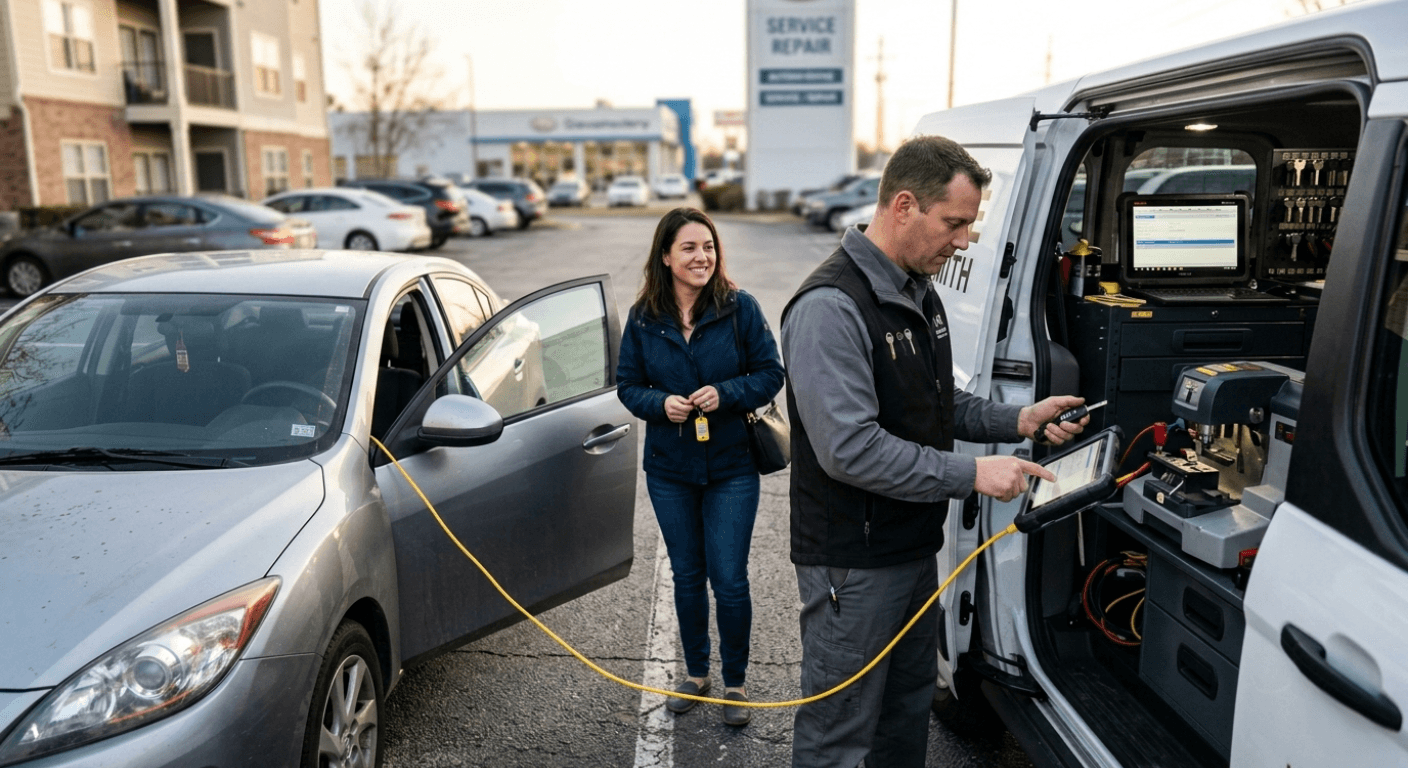
Close-up of a professional mobile locksmith technician programming a transponder car key on-site next to a customer's vehicle, with a branded van visible in the background. Clean, editorial-style photography with warm natural light. No stock-photo feel.
24/7 LIVE DISPATCHING
Every missed call is a missed job.
Our human dispatchers answer for you around the clock.
Nearly 28% of Americans misplace their car or house keys at least once per week, making keys the second most commonly lost personal item—reported by 37% of people surveyed. The collective economic toll is staggering: Americans spend an estimated $2.7 billion per year replacing misplaced possessions, with keys consistently ranking among the top three most-lost items. The average person dedicates 2.5 days annually just searching for things they've misplaced.[1]
When a driver loses a car key—or simply needs a duplicate—they enter a fragmented, opaque market. Dealerships charge premium prices, often 40–60% more than a mobile locksmith, and turnaround can stretch to weeks. Mobile locksmiths, by contrast, arrive in 15–45 minutes and complete most car key copy and key duplication jobs in 30 minutes to 2 hours on-site. The North American car key replacement services market was valued at $1.8 billion in 2024, with the U.S. accounting for the majority of service requests, particularly for transponder and smart key systems.[1]
For locksmith SMBs—especially those serving high-density East Coast markets—this demand represents both a massive revenue opportunity and an operational challenge. The businesses that answer every call and dispatch fast capture the revenue. Those that don't leave hundreds of thousands of dollars on the table annually.
How Big Is the Car Key Duplication Market, Really?
The numbers paint a clear picture of persistent, growing demand driven by structural forces in the U.S. vehicle fleet and advancing key technology.
Metric
Value
Source
Total U.S. registered vehicles (2023)
284.6 million
FHWA/Statista[1]
North America car key replacement market (2024)
$1.8 billion
Dataintelo[1]
Global car key replacement market (2024)
$7.2 billion, projected to reach $12.1B by 2033 at 5.8% CAGR
Dataintelo[1]
U.S. locksmith industry market size (2025)
$2.9 billion
IBISWorld[1]
U.S. locksmith businesses (2025)
29,304
IBISWorld[1]
BLS-reported locksmith employment (May 2023)
14,790
BLS OES[1]
A UK study by OSV found that 47% of all drivers lose their car keys on a regular basis, 28% of drivers own only one set of keys with no spare, and one in five drivers misplaces keys at least once per week. Green Flag data from 2024 recorded a car key-related callout every seven minutes, with 62% caused by drivers locking keys in the car, 21% by keys jammed in the ignition, and 12% by lost keys. While these figures originate from UK-based surveys, the behavioral patterns are mirrored in U.S. markets where spare key ownership remains comparably low.[1]
Car key duplication is not a discretionary purchase. It is an urgent, frequently recurring service need driven by deeply embedded human behavior that is unlikely to diminish.
Why Transponder and Smart Key Technology Amplifies Demand
Modern vehicles have moved far beyond the simple metal key that could be duplicated at a hardware store for a few dollars. Transponder keys now account for approximately 91.8% of the automotive key product market. Over 80% of new vehicle models in the U.S. featured keyless entry systems as of 2023, and the automotive smart keys market was valued at $13.2 billion globally in 2024, growing at a 6.8% CAGR.[1]
This technological shift creates two critical dynamics for locksmith SMBs:
Consumers cannot self-serve. Unlike mechanical keys, transponder and smart keys require specialized programming equipment that only trained locksmiths and dealerships possess.[1]
The expertise gap raises willingness to pay. The programming knowledge required elevates the perceived and actual value of the service, supporting premium pricing for qualified mobile locksmiths.[1]
Licensed locksmiths possess 99% of all transponder programming codes, matching dealership capability at a fraction of the cost. This is the foundation of the mobile locksmith value proposition for car key copy services.[1]
Mobile Locksmith vs. Dealership: What the Data Shows
The cost and convenience comparison between mobile locksmiths and car dealerships is not a matter of opinion—it is well-documented across multiple pricing studies and industry analyses.
Service Type
Locksmith Cost
Dealer Cost
Locksmith Savings
Basic key cut
$50–$100
$100–$200
~50%[1]
Transponder key programming
$75–$200
$200–$400
40–60%[1]
Key fob replacement
$100–$250
$250–$500
~50%[1]
Smart key (proximity fob)
$200–$400
$400–$600+
~40%[1]
Emergency on-site service
$100–$300
Not available
N/A[1]
J.D. Power's pricing guide confirms the gradient: a traditional mechanical key costs $10–$12 to replace at a dealer, but a transponder key runs $200–$250 and a smart key approximately $320.[1]
Speed and Convenience: The Operational Divide
Beyond cost, the service delivery model differs fundamentally:
Response time: Mobile locksmiths arrive in 15–45 minutes and complete most car key services on-site. Dealerships often require the vehicle to be towed to the location and may take 3–4 weeks for key replacement.[1]
On-site service: Mobile locksmiths come to the customer's location—a critical advantage for stranded drivers. Dealerships do not offer emergency or on-site service.[1]
Programming capability: Licensed locksmiths carry the same transponder programming codes as dealerships, covering 99% of all vehicles.[1]
McKinsey research indicates that consumer tolerance for friction and inconvenience continues to decrease, with expectations for service speed becoming "table stakes" across all service industries. For car key copy customers—who are often locked out, stranded, or late—speed isn't a preference. It's the decision-making factor.[1]
Why Every Missed Call Costs Locksmith SMBs $150–$400
The pathway from "I need a car key copy" to "I'm paying for the service" is overwhelmingly mobile, local, and phone-driven. Understanding this consumer journey reveals why call handling is the single highest-leverage operational variable for locksmith revenue.
According to multiple research sources:
46% of all Google searches carry local intent, and 76% of consumers who conduct a local search visit a business within 24 hours.[1]
78% of local mobile searches result in an offline purchase within 24 hours, with 73% of those purchases occurring in a physical store or via phone call.[1]
64% of users searching for locksmith services do so on mobile devices.[1]
Google Ads conversion rates for locksmiths range from 30–50%, among the highest in local services.[1]
Phone Calls Are the Highest-Value Conversion Channel
For locksmith SMBs, the phone call isn't just one channel among many—it is the primary revenue mechanism. The data is unambiguous:
Metric
Value
Source
Phone calls vs. web leads (revenue)
10–15x more revenue
BIA/Kelsey[1]
Callers convert faster than web leads
30% faster
Forrester/Marchex[1]
Callers spend more per transaction
28% more
Forrester/Marchex[1]
Caller retention rate vs. web leads
28% higher
Forrester/Marchex[1]
Home services phone lead conversion rate
46%
Invoca 2025 Report[1]
Local marketers rating calls as best lead source
64%
BIA/Kelsey[1]
Business callers who speak with a live person
61%
Invoca 2025 Report[1]
Every missed call represents not just a single lost transaction but potentially a lifetime customer relationship. Research indicates that 68% of customers who receive excellent emergency service become repeat clients for non-emergency work.[1]
The Compounding Cost of Operational Inefficiency
The financial consequences of missed calls and slow dispatch are well-documented and severe:
Every missed emergency call represents an immediate revenue loss of $150–$400.[1]
Locksmith companies lose an estimated 30–40% of potential emergency call revenue due to operational inefficiencies, including missed calls, delayed responses, and poor dispatch coordination.[1]
Average sales per locksmith location are approximately $800,000 annually, meaning a 30–40% revenue leak from missed calls could represent $240,000–$320,000 in lost annual revenue per location.[1]
Manual dispatch processes for emergency calls typically consume 8–15 minutes per call before a technician is even assigned.[1]
Consider a simple scenario: A locksmith SMB misses just 5 emergency car key calls per week at an average value of $250 each. That equates to $1,250 per week, or $65,000 per year in directly lost revenue—before factoring in the lifetime value of those customers or referral revenue lost.
East Coast Markets: Higher Stakes, Higher Opportunity
Bureau of Labor Statistics occupational data reveals strong locksmith employment concentrations in key East Coast metropolitan areas, with wages that support premium pricing for mobile key duplication services:[1]
Metropolitan Area
Locksmith Employment
Hourly Mean Wage
Annual Mean Wage
New York-Newark-Jersey City
990
$28.67
$59,630[1]
Miami-Fort Lauderdale-West Palm Beach
350
$22.62
$47,050[1]
Washington-Arlington-Alexandria
350
$29.79
$61,970[1]
Boston-Cambridge-Nashua
320
$30.13
$62,670[1]
Atlantic City-Hammonton, NJ
60
$30.05
$62,490[1]
East Coast states with significant locksmith employment include New York (1,050 jobs; $58,360 mean annual wage), Florida (1,180 jobs; $44,740), Maryland (340 jobs; $57,550), Massachusetts (380 jobs; $61,490), and the District of Columbia (50 jobs; $71,120—the highest-paying jurisdiction nationally).[1]
The higher wage and cost structure on the East Coast directly supports premium pricing for mobile car key copy and key duplication services, increasing the per-call revenue opportunity. When each captured call is worth more, the cost of a missed call escalates proportionally.
The Dispatch Speed Advantage: Research-Backed Evidence
Fast, reliable dispatch is not merely a marketing claim—it is a measurable driver of revenue and customer retention, supported by operational case studies.
A case study of a 24/7 locksmith service implementing optimized dispatch found:[1]
Average emergency response time dropped from 68 minutes to 34 minutes—a 50% reduction.
Customer satisfaction scores increased by 47%.
Technician productivity improved by 29%, from 4.8 to 6.2 jobs per day.
Separately, ArionERP research found that locksmith businesses using manual scheduling lose up to 18% of potential revenue due to dispatching errors and inefficient routing. Optimized dispatch systems yield a 20%+ increase in technician utilization and a 15% reduction in average response time.[1]
Key Performance Benchmarks for Automotive Locksmiths
Industry KPIs provide context for what operational excellence looks like in car key duplication:[1]
Target job turnover time: 20–30 minutes per service call
Parts cost benchmark: Under 35% of total revenue
Labor cost target: 20–30% of revenue
Gross profit margin target: 40–50%
These benchmarks are achievable—but only when the operational infrastructure from call answering through technician dispatch is functioning without gaps. A human answering every call, combined with efficient dispatch coordination, is the connective tissue that makes these KPIs attainable.
The Strategic Gap: Human-Answered Calls and Rapid Mobile Dispatch
The convergence of several research-supported trends creates a clear strategic opportunity for human-only call answering and dispatch services supporting mobile locksmith key duplication:[1]
1. High-frequency demand signal. With 284.6 million registered vehicles, near-universal key loss behavior (28% of people lose keys weekly), and 28% of drivers lacking a spare key, the demand pipeline for car key copy services is both large and recurring.[1]
2. Phone-call primacy. Phone calls generate 10–15x more revenue than web leads, convert 30% faster, and produce 28% higher spend per transaction. For an industry where 64% of searches occur on mobile and 78% of local mobile searches convert to purchases within 24 hours, ensuring every inbound call is answered by a live human is the single highest-ROI operational investment.[1]
3. Dispatch speed as competitive moat. With 30–40% of emergency call revenue lost to operational inefficiencies and optimized dispatch systems cutting response times by 50%, the gap between locksmith SMBs with professional dispatch support and those without is measured in hundreds of thousands of dollars annually.[1]
4. Cost advantage narrative. The 40–60% savings of locksmith service over dealership pricing, combined with on-site mobile service delivery in under an hour, creates a compelling economic argument—but only if the locksmith answers the phone when the customer calls.[1]
5. Booking optimization through human dispatch. Invoca's 2025 analysis of 60 million phone calls found that 37% of phone leads convert during the call itself, and 61% of callers speak directly with a live person. For locksmith SMBs, this means human answering isn't merely a preference—it is a conversion mechanism. Automated or missed calls forfeit the 46% conversion rate achievable in home services phone interactions.[1]
What This Means for Locksmith Business Owners
The car key duplication market is not shrinking. Vehicle complexity is increasing. Consumer expectations for speed are intensifying. And the data consistently shows that phone calls—answered by live humans—convert at rates that dwarf every other channel.
The operational question facing every locksmith SMB is not whether demand exists for car key copy services. It does, at scale, and it is growing. The question is whether the business infrastructure—from the first ring of the phone to the technician arriving on-site—is built to capture that demand or leak it to competitors who answer faster.
For locksmith companies operating on the East Coast, where per-call revenue is higher and market density supports premium pricing, the economic case for professional human-answered dispatch is particularly compelling. The research supports a straightforward conclusion: the locksmith businesses that answer every call, dispatch efficiently, and arrive fast will capture a disproportionate share of a $1.8 billion market. Those that rely on voicemail, delayed callbacks, or understaffed phone lines will continue losing $240,000–$320,000 annually in recoverable revenue.[1]
||| KeyDispatchers provides human-only answering and dispatch built specifically for locksmith SMBs. No bots. No voicemail. Every call answered. Learn more at keydispatchers.com |||
Sources cited in this article include data from the Bureau of Labor Statistics (OES, May 2023), FHWA/Statista vehicle registration data, IBISWorld U.S. locksmith industry reports, Dataintelo Car Key Replacement Services Market Report (2025), Invoca 2025 Call Conversion Industry Benchmarks, BIA/Kelsey local marketing research, Forrester Consulting/Marchex phone call conversion studies, McKinsey & Company consumer trends research, OSV driver key survey (2017), Green Flag internal data (2024), Pixie Lost & Found Survey (2017), ArionERP locksmith scheduling research, and J.D. Power automotive key pricing guides. All statistics are derived from the KeyDispatchers DeepSearch Authority Report.