Introduction: The Equipment Decision That Quietly Defines Profitability
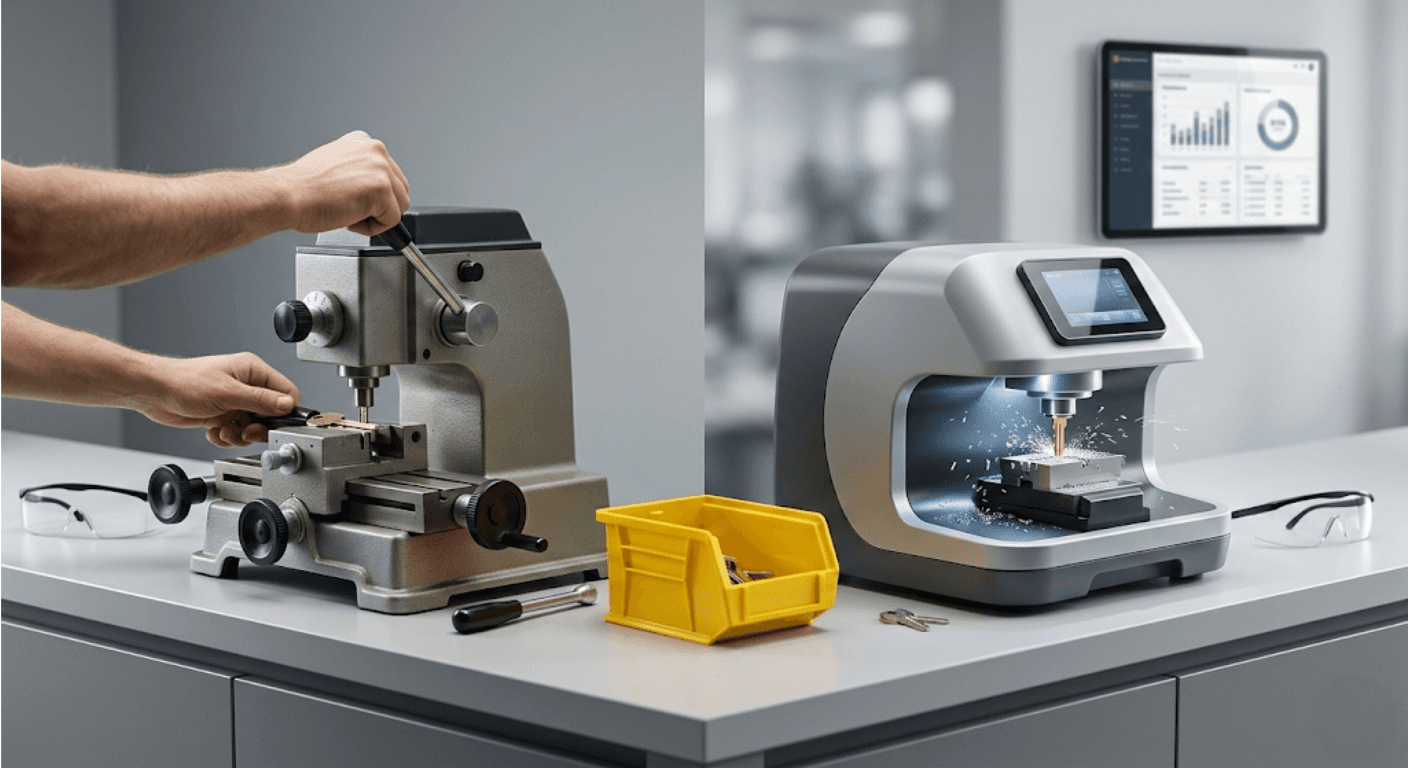
Within a U.S. locksmith industry valued at $3.0 billion, key duplication alone constitutes a $2.3 billion global sub-industry growing at approximately 8% annually. Yet one of the most consequential capital decisions an SMB locksmith faces — manual versus automatic key duplicator — receives remarkably little empirical attention.[1][2]
The numbers tell a clear story. Manual key duplicators carry re-cut rates of 5–8%, while fully automatic machines virtually eliminate this variance, achieving re-cut rates below 1%. Each callback driven by a failed key cut costs between $150 and $300 in labor alone, eroding customer trust and consuming technician hours that could generate new revenue. For East Coast locksmiths operating in high-wage metro corridors from Boston to Washington, D.C., these hidden costs compound faster than in any other region of the country.[3][4]
This analysis examines the research-backed evidence behind the manual-versus-automatic decision, quantifies the downstream economic impact for small locksmith businesses, and identifies the strategic opportunity that most operators overlook.
The Accuracy–Revenue Equation: Why Re-Cut Rates Are a Financial KPI
Key cutting accuracy is not merely a technical specification — it is the foundational variable linking equipment choice to business outcomes. The Associated Locksmiths of America (ALOA) includes "Key Duplication Techniques and Equipment" as a mandatory examination category for professional certification, underscoring its centrality to the trade.[5]
Independent testing referenced by ALOA demonstrates that machines equipped with hardened steel follower arms and dual-point clamping systems consistently achieve less than 0.001-inch repeatability across 100+ consecutive cuts. By contrast, budget-tier machines with aluminum arms and single-screw clamps exhibit deviation exceeding ±0.004 inches after only 25 cuts. This degradation compounds across a workday: a locksmith cutting 40–50 keys daily on a poorly calibrated manual machine faces cumulative precision loss that directly translates into customer callbacks.[3]
Industry testing data reveals a clear accuracy hierarchy across machine types:
The key cutting accuracy rate is tracked as a core KPI for locksmith businesses, and the industry benchmark for job completion rate (resolved without follow-up visit) is 90%+. Even marginal improvements in first-cut accuracy yield disproportionate financial returns.[3]
Callback Economics: The Hidden Cost Most Locksmiths Fail to Quantify
Systematic quality assurance research in the locksmith field indicates that callbacks cost between $150 and $300 per incident in labor alone. But the true cost extends well beyond the immediate re-cut.[3]
According to locksmith industry quality assurance research:
Automated quality verification systems can reduce locksmith callbacks by up to 87%[3]
Systematic checks add only 3–5 minutes per job while eliminating 90-minute return visits[3]
Industry benchmarks show a repeat customer rate of 30–60%, with higher ratios indicating stronger customer loyalty[3]
The industry-standard customer satisfaction benchmark is 85–90%[3]
Case Study: Maplewood Properties
A documented case study illustrates this dynamic clearly. Maplewood Properties, managing 1,200 rental units and duplicating approximately 220 keys per month, initially purchased a $1,900 semi-automatic machine. Within four months, re-cut rates climbed to 11%, with tenants reporting keys sticking in deadbolts. After upgrading to a premium model with reinforced arm assembly and dual-clamp design:[3]
Re-cut rate dropped from 11% to 0.7%[3]
Setup time fell from 14 to 4 minutes per key[3]
The $2,800 cost differential was recovered in 5.3 months[3]
This pattern — short payback periods driven by callback reduction and throughput gains — repeats across the locksmith industry.
||| For locksmiths managing high callback rates, understanding the equipment-quality-revenue connection is the first step toward protecting margins. Explore how KeyDispatchers helps locksmith businesses optimize their service operations at keydispatchers.com. |||
Comparative Analysis: Manual vs. Automatic Key Duplicators
Technical Performance Dimensions
The distinction between manual and automatic key duplicators extends across multiple engineering parameters. Manufacturer specifications commonly cite ±0.002-inch tolerance, but real-world precision depends on three interdependent factors:[3]
Spindle runout — Any wobble exceeding 0.0015 inches during cutting wheel rotation introduces chatter marks and inconsistent depth
Follower arm rigidity — Flexible arms deflect under pressure, particularly on deep-bit or serrated keys, compromising contour fidelity
Clamping consistency — Slippage of even 0.05 mm causes "ghost cuts" where the blade engages mid-groove
Automatic machines address all three variables through digital scanning, CAD-based key modeling, and CNC-style cutting that eliminates physical tracing entirely. This approach generates a 3D profile of the original key and cuts from that data, producing results independent of operator fatigue or dexterity.[3]
Feature Comparison by Machine Tier
Feature
Entry-Level Semi-Auto
Premium Semi-Auto
Full Automatic
Max Blank Thickness
0.075 in
0.095 in
0.125 in
Speed Adjustment
Fixed or 2-speed
5-step dial
Variable (1,200–6,500 RPM)
Blank Database Updates
None (manual setting)
Annual USB update
Cloud-synced, weekly
Laser-Cut Key Support
No
Limited (adapter required)
Native (optional laser module)
Average Calibration Time
8–12 minutes
3–5 minutes
Under 90 seconds
Source: Manufacturer specifications and ALOA-referenced testing[3]
Operator Dependency as a Business Risk
Manual machines require "a high level of expertise and can be time-consuming, especially for complex key patterns." In contrast, fully automated machines "require minimal human intervention," scanning the original key and cutting with computer precision to deliver "near-perfect results every time".[3]
This distinction is critical for SMB workforce planning. McKinsey research (2024) documents an imbalance of 20 job openings for every one net new employee across skilled trade roles. BLS data (May 2023) records only 14,790 employed locksmiths and safe repairers nationally, with the occupation projected to decline by approximately 11.5% between 2022 and 2032.[6][4][7]
For SMB locksmith operators, this labor scarcity means that equipment which reduces skill dependency — automatic over manual — mitigates hiring risk and enables faster onboarding of less-experienced technicians.[6][3]
The Automotive Key Factor: Why Manual Machines Are Falling Behind
The automotive key market is undergoing rapid technological evolution that fundamentally challenges the viability of manual duplicators for growth-oriented locksmith businesses.
The global automotive key blank market is valued at $6.5 billion (2025) and projected to reach $10.2 billion by 2035 at a 4.7% CAGR[8][9]
The transponder key segment is the fastest-growing at 7.9% CAGR[3]
Replacement costs for advanced transponder keys range from $40 to over $100 per key[3]
The North America automotive smart key market reached $2,281 million in 2025, growing at 8.55% CAGR[3]
Automotive locksmith services now represent 35–40% of all U.S. industry revenues. Manual duplicators cannot accommodate the narrow, asymmetric shoulder profiles of modern automotive keys (e.g., Toyota TOY44, Honda HON42), nor can they handle titanium or nickel-silver blanks that require adjustable RPM and feed rates. Fully automatic machines with variable speed control (1,200–6,500 RPM) and cloud-synced blank databases — updated weekly — natively support these evolving profiles.[3]
For locksmith businesses averaging $150 in revenue per service call, the ability to reliably duplicate high-security and automotive keys with an automatic machine opens access to the fastest-growing and highest-margin segments of the market.[3]
||| Locksmith businesses expanding into automotive and high-security key services need dispatch partners who understand the technical nuances of each call type. Learn how KeyDispatchers routes calls based on service capability at keydispatchers.com. |||
Economic Impact for East Coast Locksmith SMBs
Capital Investment and Total Cost of Ownership
The initial purchase price represents only a fraction of the total cost of equipment ownership. Key variables in the TCO calculation include:[3]
Consumable costs: A budget carbide cutter costs approximately $18 and lasts ~120 keys, while a premium-grade insert runs $42 but yields 850+ clean cuts — substantially lower per-key cost over 12 months of high-volume cutting
Software subscriptions: Annual update fees for automatic machines range from $300 to $600 — a hidden but recurring cost
Calibration labor: Automatic machines require calibration every 40–60 hours, but premium automatic units complete calibration in under 90 seconds versus 8–12 minutes for entry-level semi-automatics
SBA 7(a) loans — the SBA's primary funding program with maximum amounts of $5 million — can be used for equipment purchases including machinery. SBA 504 loans can cover up to 90% of project costs with only a 10% down payment, making higher-end duplicating equipment accessible even for smaller operations.[3]
Profitability Impact
Key duplication services carry gross profit margins of 50–75%. Standard key duplication pricing ranges from $2 to $10 per key, while automotive and high-security keys command significantly higher rates. Locksmith business owners in the duplicate key making segment typically earn between $30,000 and $70,000 annually, with mobile key services enjoying higher profit margins (30–45% net) compared to fixed-location shops (25–35% net).[3]
Implementing dynamic pricing — such as premium charges for after-hours or emergency key services — can increase profit margins by 10–15%.[3]
A Simple Revenue Model
Consider this scenario for an East Coast locksmith:
A locksmith with a manual machine misses first-cut accuracy on 6% of jobs (industry average for manual machines)
At 50 key cuts per day, that is 3 failed cuts daily
At a conservative $175 per callback (midpoint of $150–$300 range), that represents $525 in daily callback costs
Over a 5-day work week, callback-related losses total $2,625 per week — or $136,500 annually
Switching to an automatic machine with <1% re-cut rates could recover the vast majority of those losses
Even accounting for the $2,000–$6,200 investment in an automatic machine and $300–$600 in annual software fees, the payback period is measured in weeks, not years.[3]
East Coast Regional Wage Data
BLS data (May 2023) reveals that East Coast metropolitan areas represent some of the highest-paying and most concentrated locksmith markets in the nation:[4][7]
East Coast Metro Area
Employment
Hourly Mean Wage
Annual Mean Wage
New York-Newark-Jersey City, NY-NJ-PA
990
$28.67
$59,630
Washington-Arlington-Alexandria, DC-VA-MD-WV
350
$29.79
$61,970
Boston-Cambridge-Nashua, MA-NH
320
$30.13
$62,670
Miami-Fort Lauderdale-West Palm Beach, FL
350
$22.62
$47,050
Atlantic City-Hammonton, NJ
60
$30.05
$62,490
Richmond, VA
110
$25.05
$52,100
Source: U.S. Bureau of Labor Statistics, Occupational Employment and Wage Statistics, May 2023[4]
District of Columbia locksmiths earn the highest mean wages nationally at $34.19/hour ($71,120 annually), followed by Rhode Island ($32.05/hour) and Massachusetts ($29.56/hour). These elevated labor costs make operator-dependent manual machines proportionally more expensive to operate — every minute of additional setup time and every callback driven by inaccurate cuts carries a higher dollar cost in East Coast markets.[7]
New York (1,050), Florida (1,180), and New Jersey are among the top five states for locksmith employment. The competitive density in these markets means that service speed and first-cut reliability directly determine customer acquisition and retention.[7]
The Equipment–Quality–Trust Gap: A Strategic Opportunity
A research-supported gap exists at the intersection of equipment capability, service quality, and customer trust. The data reveals a consistent pattern:[3]
Quality automation reduces callbacks. Automated quality verification systems can reduce locksmith callbacks by up to 87%, with systematic checks adding only 3–5 minutes per job while eliminating 90-minute return visits.
First-call resolution drives repeat business. Industry benchmarks show a repeat customer rate of 30–60% for locksmith businesses, with job completion rate benchmarks exceeding 90% among leading locksmiths.
Customer satisfaction correlates with precision. The industry-standard customer satisfaction benchmark is 85–90%, with key cutting accuracy rate explicitly listed as a core KPI alongside response time and service call conversion.
Why This Matters for Dispatch and Call Handling
For locksmith businesses relying on answering services and dispatch coordination, the equipment decision has direct downstream effects on call handling efficiency:[3]
Dispatch accuracy depends on technician preparedness. When a dispatched locksmith arrives with the wrong equipment or a machine that cannot handle the requested key type, the result is a failed service call — which must then be re-routed, consuming additional time and eroding the end customer's experience.
Booking optimization requires equipment knowledge. Effective dispatchers who understand whether a locksmith's equipment can handle automotive transponder keys versus standard residential keys can route calls more accurately, reducing mismatch rates and improving first-visit resolution.
Service quality feedback loops. High callback rates driven by poor key cutting quality generate inbound complaint calls — a volume and cost burden that could be mitigated upstream by better equipment selection.
||| For locksmith operators managing multiple technicians and service territories, human dispatchers who understand equipment capabilities can significantly reduce mismatch rates. See how KeyDispatchers structures intelligent call routing for locksmith businesses at keydispatchers.com. |||
An Overlooked Health Consideration: Lead Exposure
An additional factor relevant to equipment choice is occupational lead exposure. Brass keys typically contain 1.5–2.5% lead, and a peer-reviewed study published in the International Journal of Environmental Research and Public Health demonstrated that locksmiths had significantly higher blood lead and tibia lead concentrations than age-, sex-, and ethnically-matched controls. State-conducted studies found that lead residue on the hands of consumers handling brass keys was 19 times the California Proposition 65 "No Significant Risk Level".[10][3]
Automatic machines with enclosed cutting chambers and integrated dust extraction systems can reduce particulate exposure relative to open manual machines — a consideration for long-career locksmiths and employer liability management.[10][3]
Conclusion: Equipment Strategy Is Business Strategy
The research is unambiguous: the manual-versus-automatic key duplicator decision is not a matter of preference — it is a structural business choice with quantifiable downstream effects on callback rates, customer satisfaction, technician efficiency, and revenue capacity.
For East Coast SMB locksmiths operating in high-wage, high-competition metro markets, the economic case for automatic key duplication equipment is reinforced by every data point examined — from the 5–8% re-cut rates of manual machines versus <1% for automatics, to the $150–$300 per-callback cost burden, to the rapidly expanding automotive key market that manual machines simply cannot serve.[4][3]
The locksmiths who align their equipment capabilities with evolving key technology — and pair that investment with intelligent dispatch and call handling systems that understand what each technician can deliver — will capture the highest-margin work in the industry's fastest-growing segments.
||| Ready to ensure every inbound call reaches the right technician with the right equipment? Explore KeyDispatchers' human-only answering and dispatch service built specifically for locksmith SMBs at keydispatchers.com. |||
KeyDispatchers provides human-only answering and dispatch services for SMB locksmith companies across the United States, with specialized expertise in East Coast emergency service markets.