Introduction
For many locksmith owners, the hardest part of trying a dispatch service is not deciding whether they need help. It is worrying that setup will be slow, confusing, or disruptive.
That is exactly why the KeyDispatchers onboarding process is built to be simple. The goal is not to bury locksmith businesses in complicated forms or weeks of back-and-forth. The goal is to get your phones covered, your Workiz workflow aligned, and your jobs handled properly by real people as fast as possible.
KeyDispatchers is designed for small and mid-sized locksmith businesses that need a reliable dispatch partner without the overhead of hiring an in-house team. That is why the process starts with a free 3-day trial before any real commitment.
Why onboarding matters
A dispatch service should not just answer the phone. It should sound like your company, follow your rules, qualify the caller correctly, and push the job into the right workflow.
That only happens when onboarding is done properly.
A rushed setup creates mistakes. Prices get quoted wrong. Service areas get misunderstood. Jobs go to the wrong technician. Customers get mixed messages. For locksmith businesses, that kind of confusion costs real money.
A good onboarding process does the opposite. It gives your dispatch team the context they need to answer with confidence, book jobs cleanly, and support your technicians without creating extra cleanup work for you later.
Step 1: Intro call and business fit check
The process starts with a simple intro conversation.
This is where KeyDispatchers learns how your shop operates today. Some locksmith businesses mainly handle emergency lockouts. Others focus heavily on automotive jobs, rekeys, smart locks, or commercial service. Some owners want full booking support. Others mainly need missed-call coverage and after-hours help.
The purpose of this first step is to make sure the setup matches your real operation, not a generic template.
During this stage, the main questions usually include:
What services do you offer
What cities or zip codes do you cover
What hours do you currently answer calls yourself
Which calls should be booked immediately
Which calls should be forwarded, escalated, or declined
Whether you already use Workiz in an organized way
Whether you want basic intake, full dispatch, or start-to-finish booking
This step matters because a locksmith dispatch workflow only works when the operator understands how your business actually runs.
Step 2: Free 3-day trial setup
Before any long-term commitment, KeyDispatchers offers a free 3-day trial.
This is one of the strongest parts of your offer because it lowers risk for the customer. Instead of asking a locksmith owner to “trust the pitch,” you let them see the service in real conditions with their own calls, their own customers, and their own workflow.
The free 3-day trial also changes the tone of the sale. It feels practical, not pushy.
During the trial period, the focus is on a few simple questions:
Are calls being answered quickly
Does the operator sound professional and helpful
Are leads being captured correctly
Are jobs being booked the way the owner expects
Does the flow inside Workiz make sense
Does the service actually reduce pressure on the owner or office staff
A trial like this is especially valuable for smaller locksmith shops because they do not want to gamble on a service that creates more admin work than it removes.
Step 3: Business rules and call flow mapping
Once the trial starts, the next step is building your call-handling rules.
This is where KeyDispatchers becomes an extension of your brand instead of just a phone-answering service.
The dispatch team needs to know things like:
How your business should be introduced on the phone
Which services you want prioritized
Which jobs need immediate dispatch
Which jobs need owner approval first
What minimum pricing or service-call language should be used
Which neighborhoods, cities, or counties are in or out of range
How to handle difficult callers, low-quality leads, or vague inquiries
What to do with after-hours commercial calls versus residential lockouts
This is one of the most important parts of onboarding because it prevents inconsistency. A locksmith business grows when the customer experience feels clear and reliable from the first call.
Step 4: Workiz connection and workflow setup
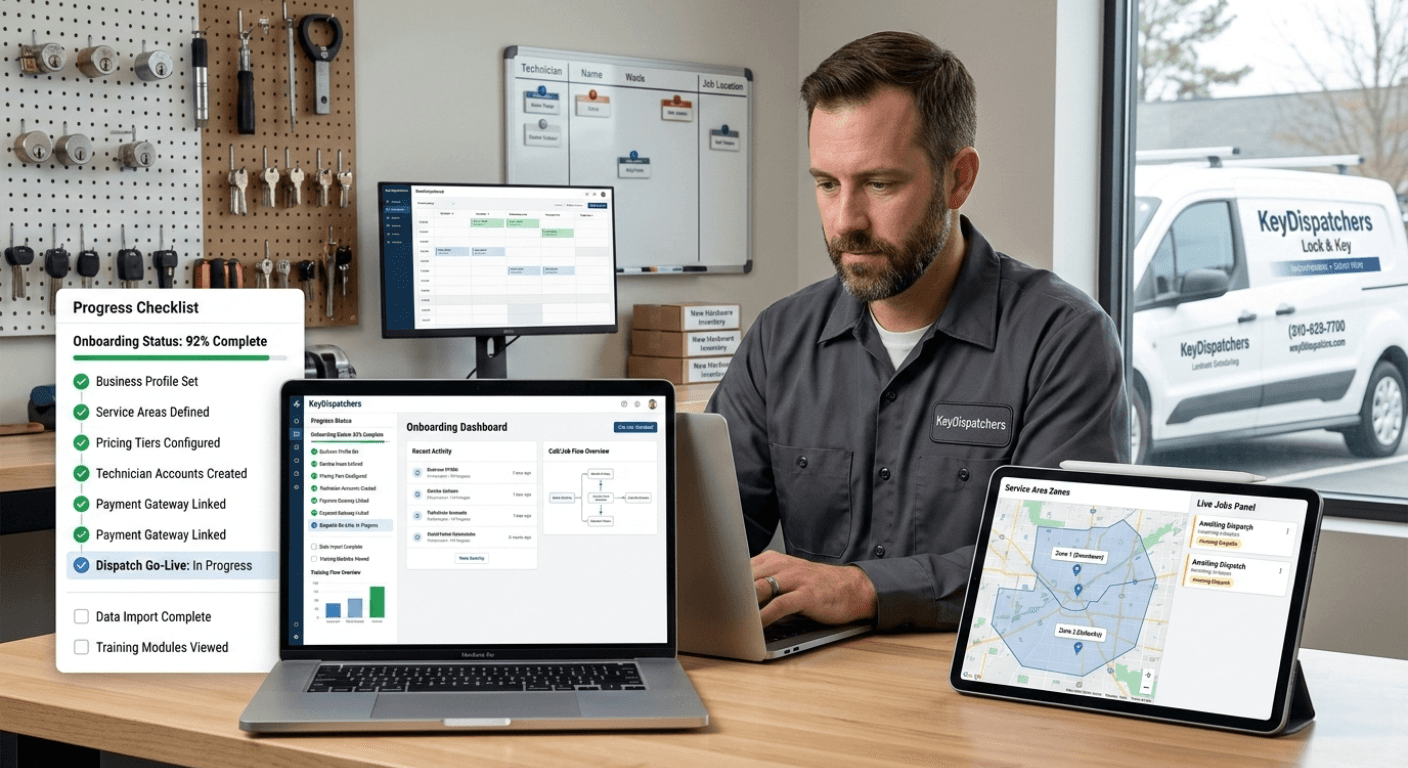
Because KeyDispatchers works inside Workiz, onboarding also includes aligning the account structure and workflow.
This is not just about “having access.” It is about making sure the dispatch process fits the way your team already works.
That usually includes reviewing:
Job types
Tags
Statuses
Technician assignments
Notes structure
Scheduling preferences
Customer data fields
Follow-up expectations
Internal comments versus customer-facing information
If this step is skipped, even good call handling can turn messy later. Calls may be answered well, but the handoff inside the system becomes sloppy. That leads to missed notes, wrong routing, duplicate entries, or confusion for technicians in the field.
When this part is done right, everything feels tighter. The dispatcher knows where the job belongs. Your team knows what was promised. The customer gets a smoother experience.
Step 5: Script and tone alignment
One of the biggest fears locksmith owners have with outsourced dispatch is this: “Will they sound like my company?”
That is why script and tone alignment matters so much.
KeyDispatchers should not sound robotic, overly formal, or disconnected from the locksmith trade. The operator should sound calm, useful, and trained. Customers calling in stressful situations need someone who sounds confident and clear.
During onboarding, the script should be shaped around your brand voice:
Friendly but direct
Professional without sounding corporate
Helpful in urgent situations
Clear on next steps
Consistent on pricing language and limitations
This is also where your newer brand language can help. Phrases like “Powered by smart systems, operated by helpful humans” and “Locksmith-industry-trained operators” support a tone that is modern but still human.
Step 6: Trial goes live
Once the basics are in place, the free 3-day trial goes live.
This is where the setup stops being theoretical.
Real calls start coming in. Real customers ask real questions. Operators begin qualifying leads, logging details, and booking or routing calls based on your rules.
This stage is important because it reveals small issues fast:
A pricing phrase may need adjustment
A service area may need to be narrowed
A tag inside Workiz may not be useful
Certain call types may need a different escalation rule
One technician may prefer a different dispatch sequence
These are normal adjustments. In fact, they are one of the main reasons a trial works so well. Instead of pretending the first setup draft will be perfect, the process allows both sides to refine the workflow using live feedback.
Step 7: Review and optimization
At the end of the trial, the account should be reviewed together.
This review should focus on practical performance, not fluff.
Questions to answer include:
How many calls were handled
How many leads were captured
How many jobs were booked
Were there any call-handling mistakes
Was the customer tone right
Did Workiz updates look clean
Did the owner save time
Did the team feel less pressure
Did the service catch calls that would otherwise have been missed
This part is where the value becomes obvious. A good dispatch partner is not judged by promises alone. It is judged by whether the owner feels more organized, more covered, and less exposed to missed revenue.
What locksmith owners should prepare before starting
The onboarding process moves fastest when the locksmith business has a few basics ready.
That includes:
Your business name and preferred phone greeting
A current service list
Main service areas
Basic pricing rules or minimums
Hours and escalation preferences
Technician names and dispatch preferences
Workiz access
Notes on calls you do not want booked
This does not need to be perfect. But the clearer these basics are, the faster the dispatcher can begin handling calls the right way.
Why the free 3-day trial matters
A lot of service companies claim they are easy to start with. Very few reduce risk in a meaningful way.
The free 3-day trial does.
It gives locksmith owners a no-pressure way to test whether KeyDispatchers actually fits their workflow. It also helps prove the difference between generic answering and true locksmith dispatch support.
That matters because answering the phone is only part of the job. The real value is in booking accurately, handling urgency well, staying organized in Workiz, and making the owner feel like someone finally took the phone burden off their shoulders.
Final thoughts
A strong onboarding process does not need to feel corporate or complicated. It just needs to be clear, fast, and built around how locksmith businesses really operate.
That is what makes the KeyDispatchers setup model attractive. It is practical, human, and easy to test before making a commitment.
For small and mid-sized locksmith businesses, that combination matters. You get the structure of a real dispatch operation, but without being forced into a heavy enterprise-style process.
If your shop is missing calls, juggling dispatch manually, or trying to grow without adding office overhead, the smartest next step may not be hiring more internal staff. It may be starting with a free 3-day trial and seeing how much smoother the business runs when every call is handled properly from the start.