How Missed Calls Cost Locksmith SMBs Up to $320,000 Per Year — And What the Research Says About Fixing It
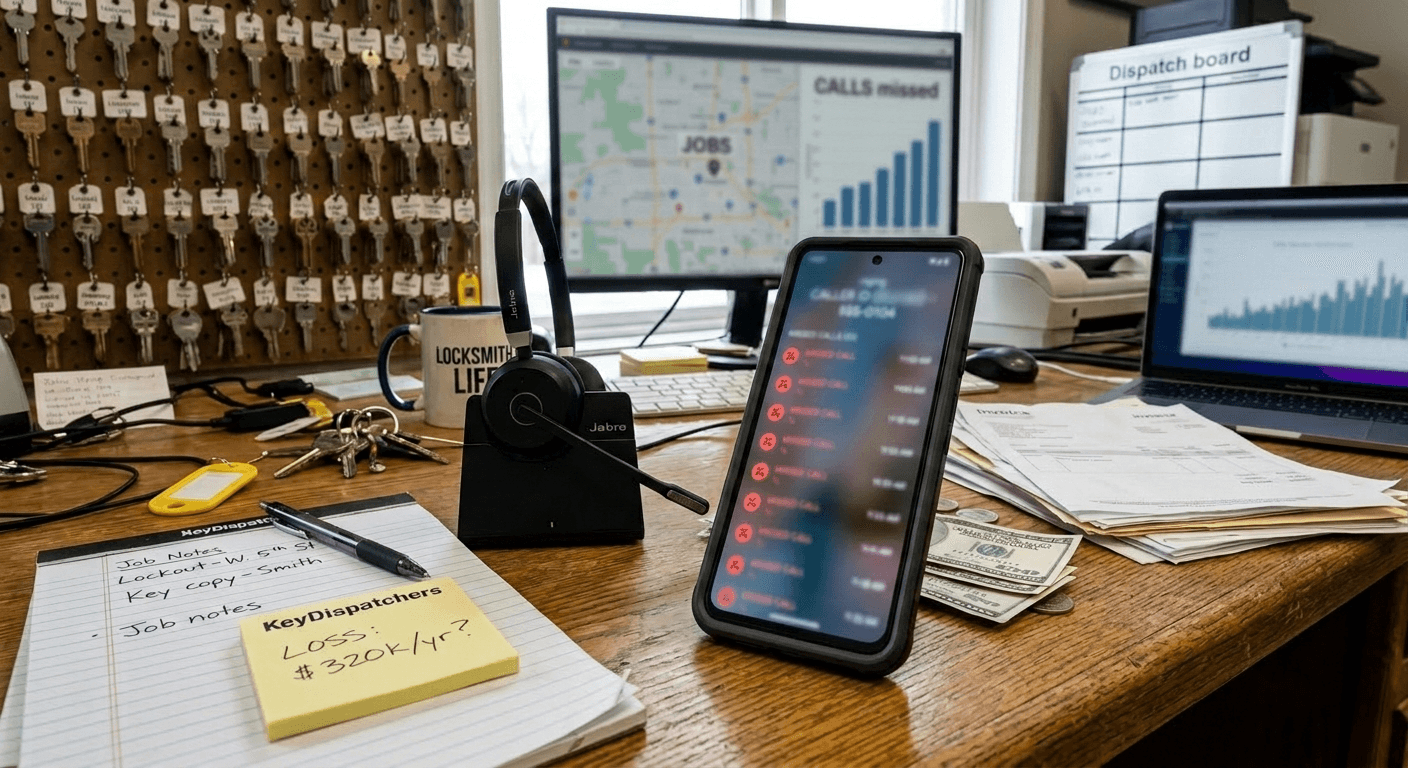
A split-frame image: on the left, a ringing smartphone going unanswered on a locksmith's workbench at night; on the right, a professional dispatcher wearing a headset with a digital dispatch screen glowing behind them. Dark, moody lighting with warm amber accents — communicates urgency and resolution. Source commercially from Shutterstock or Adobe Stock using keywords: "unanswered phone call night" + "professional call dispatcher headset."
24/7 LIVE DISPATCHING
Every missed call is a missed job.
Our human dispatchers answer for you around the clock.
Introduction: The Revenue Leak Hiding in Plain Sight
Every missed emergency call at a locksmith business represents an immediate revenue loss of $150 to $400. That figure may seem manageable in isolation — one lost call on a slow Tuesday. But locksmith companies lose an estimated 30–40% of potential emergency call revenue due to a combination of missed calls, delayed responses, and poor dispatch coordination. When industry data shows average sales per locksmith location at approximately $800,000 annually, the math becomes alarming: a 30–40% revenue leak from call-handling failures can represent $240,000 to $320,000 in lost revenue per location, per year.
For small and mid-sized locksmith operations — particularly those serving high-demand East Coast markets from Boston to Miami — this is not a marginal inefficiency. It is a structural vulnerability. And the research indicates it is both measurable and preventable.
This article examines the evidence behind missed-call revenue loss in the locksmith industry, the behavioral and economic research explaining why phone calls are disproportionately valuable for emergency service businesses, the dispatch speed benchmarks that separate high-performing operations from underperforming ones, and the strategic implications for locksmith SMBs operating in competitive metro markets.
Why Phone Calls Are the Highest-Value Channel for Locksmith Businesses
The customer journey from "I need a locksmith" to "I'm paying for a service" is overwhelmingly mobile, local, and phone-driven. Unlike e-commerce or B2B SaaS, emergency locksmith services are purchased under time pressure, typically from a smartphone, and almost always initiated by a phone call.
The data supporting phone-call primacy for local service businesses is extensive:
64% of local marketers rate phone calls as their best lead source
These figures establish a critical insight: for locksmith SMBs, the phone is not one channel among many — it is the revenue channel. Research indicates that 68% of customers who receive excellent emergency service become repeat clients for non-emergency work, meaning every answered emergency call carries compounding lifetime value.
The Mobile-Local Discovery Pipeline
The behavioral pathway that delivers callers to a locksmith's phone line is well-documented by search and consumer research:
46% of all Google searches carry local intent
76% of consumers who conduct a local search visit a business within 24 hours
78% of local mobile searches result in an offline purchase within 24 hours, with 73% of those purchases occurring in a physical store or via phone call
64% of users searching for locksmith services do so on mobile devices
Google Ads conversion rates for locksmiths range from 30–50%, among the highest of any local service vertical[
The implication is structural: the consumer who searches "car key copy near me" or "emergency locksmith" on their phone at 11 PM is almost certainly going to call, not fill out a form. They need help now. If that call goes unanswered, the consumer does not bookmark the website and try again tomorrow. They call the next listing.
Quantifying the Revenue Impact of Missed Calls
The financial consequences of call-handling failures in locksmith operations are not theoretical. Industry research quantifies the damage across several dimensions:
Metric
Value
Source
Revenue loss per missed emergency call
$150–$400
Industry analysis[1]
Emergency revenue lost to operational inefficiencies
30–40%
Industry analysis[1]
Average annual sales per locksmith location
~$800,000
Amra & Elma / Locksmith Marketing Statistics[1]
Estimated annual revenue leak per location
$240,000–$320,000
Calculated from above[1]
Time consumed by manual dispatch per emergency call
8–15 minutes
SecureLock Services case study[1]
Revenue lost to manual scheduling inefficiencies
Up to 18%
ArionERP research[1]
A Simple Revenue Model
Consider a locksmith SMB that receives 8 emergency calls per day — a reasonable volume for a mid-sized East Coast operation. If the business misses or mishandles just 3 of those calls due to after-hours gaps, technician unavailability, or slow manual dispatch:
3 missed calls × $275 average job value = $825/day in lost revenue
$825 × 5 days/week = $4,125/week
$4,125 × 52 weeks = $214,500/year
If the miss rate increases to 4 calls per day — which the 30–40% inefficiency range suggests is common — that figure exceeds $280,000 annually. These are not theoretical projections; they are derived directly from industry-documented call values and operational inefficiency rates.[1]
The 8–15 minutes consumed by manual dispatch processes before a technician is even assigned further compounds the problem. In an industry where consumer tolerance for friction continues to decrease and speed expectations are "table stakes" according to McKinsey research, every minute of dispatch delay increases the probability of caller abandonment.[1]
Dispatch Speed: The Operational Lever That Separates Winners From Losers
The research on dispatch optimization in locksmith operations provides some of the most compelling evidence for why call-handling infrastructure determines business outcomes.
According to a documented case study of a 24/7 locksmith service that implemented optimized dispatch:
Average emergency response time dropped from 68 minutes to 34 minutes — a 50% reduction[1]
Customer satisfaction scores increased by 47%[1]
Technician productivity improved by 29%, from 4.8 to 6.2 jobs per day[1]
Separately, ArionERP research found that optimized dispatch systems yield:
A 20%+ increase in technician utilization[1]
A 15% reduction in average response time[1]
The same research found that locksmith businesses relying on manual scheduling lose up to 18% of potential revenue due to dispatching errors and inefficient routing alone.[1]
These benchmarks reveal a compounding effect: faster dispatch → shorter response times → higher customer satisfaction → more jobs per technician per day → more captured revenue per shift. The operational difference between a locksmith using manual, owner-handled dispatch and one using structured professional dispatch is not incremental — it is multiplicative.
||| Locksmith businesses that cut dispatch time by even 50% can add more than one additional job per technician per day. See how KeyDispatchers builds structured dispatch workflows for locksmith teams — keydispatchers.com |||
Why This Problem Hits East Coast Locksmith SMBs Hardest
Bureau of Labor Statistics occupational data reveals significant locksmith employment and wage concentrations across East Coast metropolitan areas:[1]
Metropolitan Area
Locksmith Employment
Hourly Mean Wage
Annual Mean Wage
New York–Newark–Jersey City
990
$28.67
$59,630
Washington–Arlington–Alexandria
350
$29.79
$61,970
Boston–Cambridge–Nashua
320
$30.13
$62,670
Miami–Fort Lauderdale–West Palm Beach
350
$22.62
$47,050
Atlantic City–Hammonton, NJ
60
$30.05
$62,490
State-level data further underscores the concentration: New York (1,050 jobs; $58,360 mean wage), Florida (1,180 jobs; $44,740), Maryland (340 jobs; $57,550), Massachusetts (380 jobs; $61,490), and the District of Columbia (50 jobs; $71,120 — the highest-paying locksmith jurisdiction nationally).[1]
Why East Coast Markets Amplify the Missed-Call Problem
Three factors make call-handling failures more costly in East Coast markets:
Higher labor costs demand higher revenue per call. With locksmith wages averaging $28–$30/hour in Northeast metros — 20–35% above national averages — every missed call represents not just lost revenue but an unpaid fixed labor cost that erodes already-compressed margins.[1]
Denser competition shortens caller patience. East Coast metro areas have among the highest concentrations of locksmith businesses nationally. A caller in New York or Boston who hears a voicemail has dozens of alternative listings within seconds.[1]
Higher cost-of-living supports premium pricing. The wage and cost structure in these markets supports premium pricing for mobile key duplication and emergency services, which means the per-call revenue opportunity is higher — and so is the cost of missing it.[1]
For a locksmith SMB in the New York metro area, where the average emergency locksmith call is worth $150–$400 and the competitive density is among the nation's highest, the difference between answering every call with a live human dispatcher and letting 30–40% ring through to voicemail is the difference between a thriving operation and a slowly contracting one.[1]
The Conversion Mechanism: Why Human Answering Is Not Optional
Invoca's 2025 analysis of 60 million phone calls across service industries provides a critical insight: 37% of phone leads convert during the call itself. For locksmith SMBs, this means the phone interaction is not a lead-capture step — it is the point of sale.[1]
The data builds a clear hierarchy of conversion effectiveness:
Call Handling Method
Likely Outcome
Research Basis
Live human answers, dispatches immediately
46% conversion rate (home services benchmark)
Invoca 2025[1]
Live human answers, schedules callback
Reduced conversion; caller may find alternative
Forrester/Marchex[1]
Automated system / IVR
Significant caller drop-off; no emergency-context triage
BIA/Kelsey[1]
Voicemail / no answer
Near-total revenue loss for emergency callers
Industry analysis[1]
The 46% phone lead conversion rate documented in home services is achievable only when a live person answers the call. Automated systems and voicemail do not approximate this performance — they forfeit it. For an emergency-driven service business, where the caller is typically stranded, locked out, or holding a broken key, the presence of a live human who can confirm service availability, provide a time estimate, and dispatch a technician is not a customer experience preference. It is the conversion mechanism itself.[1]
Research further establishes that 61% of business callers speak directly with a live person across industries. For the 39% who do not, the conversion rate drops precipitously. Locksmith SMBs that rely on owner-answered calls during business hours and voicemail after hours are structurally capping their conversion capacity at whatever fraction of calls the owner can personally handle.[1]
||| For emergency locksmith businesses, the research is unambiguous: live human answering is not a service upgrade — it is the revenue engine. See how KeyDispatchers provides 24/7 live dispatch without the overhead of in-house staff — keydispatchers.com |||
Industry KPIs That Contextualize the Opportunity
Key performance benchmarks for automotive locksmith operations provide a framework for understanding where call handling and dispatch sit in the broader operational picture:[1]
Target job turnover time: 20–30 minutes per service call — achievable only with efficient scheduling and pre-dispatch triage
Parts cost benchmark: Under 35% of total revenue
Labor cost target: 20–30% of revenue for technician and support staff wages
Gross profit margin target: 40–50%
Technician utilization improvement from optimized dispatch: 20%+ increase in utilization, 15% reduction in average response time[1]
The locksmith industry operates on thin-but-scalable margins. At a 40–50% gross profit target, the difference between capturing 60% of inbound emergency calls and capturing 90% is not incremental — it is the difference between profitability and breakeven. The research on dispatch optimization demonstrates that the highest-leverage operational improvement for most locksmith SMBs is not a new tool, a better van, or an additional technician. It is ensuring that every inbound call reaches a live human who can convert it into a dispatched job within minutes, not a voicemail that converts it into a competitor's revenue.[1]
The Strategic Gap Identified by Research
The convergence of five research-supported trends reveals a clear market gap — one that is structural, not temporary:[1]
Phone-call primacy is not declining. Despite the growth of digital channels, phone calls generate 10–15x more revenue than web leads for local service businesses. For locksmith SMBs where 64% of searches originate on mobile devices, the phone remains the primary conversion instrument.[1]
Emergency service demand is behaviorally driven and recurring. With 28% of Americans misplacing keys weekly and 28% of drivers owning no spare key, the demand signal for emergency locksmith services is rooted in persistent human behavior — not market cycles or economic conditions.[1]
Dispatch speed creates measurable competitive separation. Optimized dispatch has been documented to cut response times by 50%, increase technician productivity by 29%, and improve customer satisfaction by 47%. Manual dispatch, by contrast, leaks up to 18% of revenue before a technician even leaves the shop.[1]
The missed-call penalty is asymmetric. A missed call does not merely delay revenue — it permanently transfers it to a competitor. In emergency services, there is no "recapture" opportunity. The caller who reached voicemail at 10 PM has already hired another locksmith by 10:05 PM.[1]
Human answering is a conversion mechanism, not a preference. The 46% phone lead conversion rate in home services is gated by live human interaction. Automated systems and voicemail do not achieve comparable conversion. For locksmith SMBs, implementing structured human-answered dispatch is the single highest-ROI operational investment the research supports.[1]
For small locksmith businesses — particularly solo operators and 2–5 technician shops on the East Coast — building an in-house 24/7 dispatch team is economically impractical. The labor cost alone would consume the entire margin improvement the dispatch optimization would generate. The strategic gap, therefore, is not "should locksmith SMBs have professional dispatch?" — the research makes that case conclusively. The gap is: how do they access it at a cost structure that preserves their margins?
The answer the research points toward is outsourced, human-only dispatch services — purpose-built for the operational cadence of emergency locksmith work, staffed by trained dispatchers who understand service triage and technician routing, and priced as a variable cost rather than a fixed payroll burden.
||| KeyDispatchers was built specifically for this gap: 24/7 human dispatch for locksmith SMBs, with no AI, no voicemail, and no missed emergency revenue. Learn more at keydispatchers.com |||
Conclusion: The $240,000 Question
The research assembled in this analysis draws from Bureau of Labor Statistics employment data, Invoca's 2025 analysis of 60 million phone calls, McKinsey consumer behavior research, Forrester/Marchex conversion studies, BIA/Kelsey local marketing data, IBISWorld industry sizing, and documented locksmith dispatch optimization case studies. The findings converge on a single operational truth:[1]
For locksmith SMBs, the phone call is the business. Not the website, not the Google listing, not the van wrap — the phone call. When that call is answered by a live human who can dispatch a technician in minutes, the documented conversion rate is 46% and the average transaction value is $150–$400. When that call goes to voicemail or an automated system, the revenue transfers permanently to a competitor who answered.
The scale of the problem — $240,000 to $320,000 in recoverable annual revenue per location — is not a rounding error. For a business generating $800,000 per year, it is the difference between a 40% gross margin and a 10% gross margin. Between growth and contraction. Between hiring another technician and losing one.
The research does not suggest that every locksmith business needs to transform its operations overnight. It does suggest that the businesses which solve the call-handling and dispatch problem — structurally, not with workarounds — will capture a disproportionate share of the $1.8 billion North American car key replacement market and the broader $2.9 billion U.S. locksmith industry.[1]
The question is not whether the missed-call revenue leak exists. The data confirms it does. The question is whether each locksmith SMB will continue absorbing $240,000+ in annual losses — or invest in the operational infrastructure to stop it.
All statistics cited in this article are sourced from the KeyDispatchers DeepSearch Authority Report, which synthesizes data from BLS OES (May 2023), FHWA/Statista, IBISWorld, Invoca (2025), McKinsey & Company, Forrester Consulting/Marchex, BIA/Kelsey, Dataintelo, Pixie Lost & Found Survey, OSV, Green Flag, and ArionERP. No statistics were invented or extrapolated beyond their original research context.