
Locksmith Operations
The Pro's Kit: Essential Locksmith Tools Every Modern Tech Needs
Modern locksmith tools now require $23,600–$104,100 in startup investment. Discover the research-backed equipment guide every locksmith technician needs in 2025.
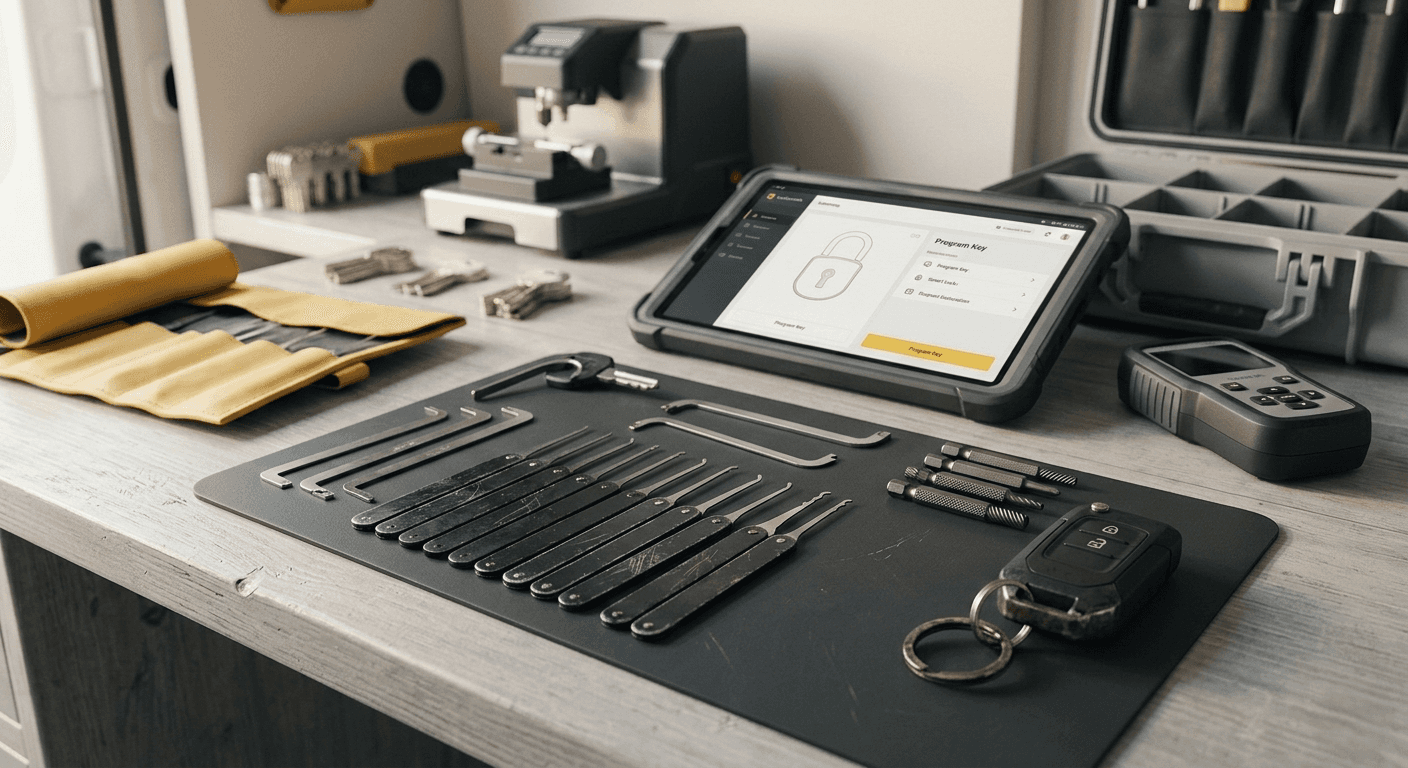
Locksmith Operations
Modern locksmith tools now require $23,600–$104,100 in startup investment. Discover the research-backed equipment guide every locksmith technician needs in 2025.
The $104,100 Question: What Does It Really Cost to Equip a Modern Locksmith?
The locksmith tools a technician carries in 2025 bear little resemblance to the pick sets and key blanks of a decade ago. According to consolidated industry research, modern locksmith toolkits now require between $23,600 and $104,100 in startup investment — a range that reflects the widening gap between basic residential service and full-service capability across residential, commercial, automotive, and electronic access control verticals. That investment gap is not arbitrary. It is driven by a measurable shift: the Locksmith Ledger 2025 State of the Industry Report found that 83.6% of locksmiths are now integrating electronic security services into their offerings.[1]
For SMB locksmith companies — particularly those operating across competitive East Coast markets — understanding the full scope of required locksmithing tools is no longer optional. It is an operational prerequisite that directly determines service capability, job ticket values, and long-term revenue potential. With the U.S. locksmith industry valued at $3.0 billion across 29,620 businesses, the market remains highly fragmented, and the technicians who invest strategically in their toolkits are the ones capturing the highest-margin work.[1]
This article examines the evidence-backed economics of locksmith tool investment, maps the essential equipment categories, and identifies the strategic implications of the industry's electronic transition — all drawn from Bureau of Labor Statistics wage data, IBISWorld market analysis, ALOA certification standards, and recognized market research.
The Locksmith Industry Landscape: Scale and Structure
The U.S. locksmith industry (NAICS 561622) generates approximately $3.0 billion in annual revenue across 29,620 establishments, according to IBISWorld's 2026 industry report. Revenue has contracted at a compound annual growth rate of -1.1% over the five years to 2026, although a modest 1.8% growth rebound is expected in 2026. The industry is highly fragmented — no single company holds more than 5% market share — which means individual SMB operators compete primarily on service capability, response time, and geographic coverage.[1]
According to the Bureau of Labor Statistics (May 2023 Occupational Employment and Wage Estimates):
National employment stands at 14,790 locksmiths and safe repairers[1]
National median hourly wage: $23.26 ($48,380 annually)[1]
National mean hourly wage: $25.06 ($52,130 annually)[1]
The 90th percentile earns $36.76/hour ($76,460 annually)[1]
The wage distribution reveals a critical insight: the gap between median and top-percentile earners exceeds $28,000 annually, suggesting that technicians with expanded service capabilities — particularly in electronic and automotive specializations — command significantly higher compensation.[1]
East Coast Wage Premiums
For locksmith companies operating in KeyDispatchers' primary East Coast service geography, the wage data reveals premiums of 17%–47% above the national median:[1]
Metro Area | Mean Hourly Wage | Mean Annual Wage | Premium vs. National Median |
Washington-Arlington-Alexandria, DC-VA-MD-WV | $29.79 | $61,970 | +28%[1] |
New York-Newark-Jersey City, NY-NJ-PA | $28.67 | $59,630 | +23%[1] |
Boston-Cambridge-Nashua, MA-NH | $30.13 | $62,670 | +30%[1] |
Atlantic City-Hammonton, NJ | $30.05 | $62,490 | +29%[1] |
District of Columbia | $34.19 | $71,120 | +47%[1] |
These East Coast wage premiums correlate directly with higher cost-of-living and higher average job ticket values in dense metro markets — making proper tool investment even more critical for capturing the full revenue potential of each service call.[1]
Section 1: The Essential Locksmith Toolkit — Equipment by Service Category
Research across multiple industry sources identifies four primary service categories, each with distinct tool investment requirements. The total startup range of $23,600–$104,100 documented in the DeepSearch report reflects the cumulative cost across these tiers.[1]
Residential Locksmith Tools
Residential locksmithing remains the foundational service category. Essential locksmith tools for residential work include:[1]
Lock pick sets and tension wrenches: $8–$50 for quality sets; required for non-destructive entry during lockouts[1]
Key cutting/duplicator machine: $300–$1,800 for basic models; semi-automatic machines like the Triton PLUS handle house, car, dimple, and barrel keys[1]
Rekeying kits: $11–$210 per brand-specific kit (Schlage, Kwikset, etc.)[1]
Pinning kits and key decoders: $10–$600 depending on complexity[1]
Lock installation kits: $10–$500 per lock type[1]
Broken key extractors: $19–$27 for professional sets[1]
A functional residential-only toolkit can be assembled for approximately $5,000–$15,000 in professional-grade equipment, according to Wexford Insurance's locksmith startup cost analysis.[1]
Commercial Locksmith Tools
Commercial work commands higher per-job revenue but requires additional investment in high-security hardware servicing, master keying systems, and access control infrastructure. The additional tool requirements for commercial-grade work push equipment costs significantly higher, particularly when factoring in:
Advanced master keying systems and restricted keyway tools
High-security cylinder servicing equipment
Door closer installation and adjustment tools
Safe and vault tools (change key sets, safe scopes, drill kits)
According to ALOA's certification framework, commercial locksmiths pursuing Certified Professional Locksmith (CPL) status must demonstrate competency across at least 14 elective categories beyond the mandatory exam — each representing a distinct equipment and skill requirement.[1]
Automotive Locksmith Tools
Automotive locksmithing represents both the highest growth area and the most capital-intensive equipment category. Key investments include:
Transponder key programmers and diagnostic tools: $500–$1,500 per unit[2]
Auto entry tool sets: Premium kits (such as the Access Tools Super Combo) include long-reach tools, air wedges, and slim jims[1]
Car key cutting machines: CNC-capable machines range from $1,000–$5,000+[1]
Auto jigglers and specialty bypass tools: $25–$102[1]
Initial key blank inventory (transponder + standard): $1,000–$4,000[2]
Total automotive locksmith equipment costs range from $2,000 to $10,000 for tools alone, with vehicle outfitting adding $5,000–$15,000. When combined with a service vehicle ($5,000–$25,000), a full automotive operation launch can exceed $50,000.[2][1]
Electronic Access Control Tools
This is where the modern locksmith toolkit diverges most sharply from traditional expectations. With 83.6% of locksmiths now integrating electronics, the electronic access control category has shifted from optional specialty to operational necessity.[1]
The global smart lock market was valued at $3.38 billion in 2025 and is projected to reach $17.10 billion by 2034, expanding at a CAGR of 19.75%. In the United States specifically, the smart lock market reached approximately $1.03 billion in 2025 and is projected to grow to $2.17 billion by 2030 at a CAGR of 16.1%. North America accounts for 40% of the global smart lock market.[3][4]
This market expansion translates directly into locksmith tool demand:
Smart lock installation and configuration tools
Network diagnostic equipment for Wi-Fi and Bluetooth-enabled locks
Biometric lock servicing equipment
Access control system programming devices
Software subscriptions for cloud-managed lock platforms
The locksmith tools market itself — valued at $86.6 million globally in 2024 — is projected to reach $99 million by 2031 at a CAGR of 2.0% for traditional tools. However, digital and electronic lock tools currently account for approximately 20% of total tool market revenue and are projected to reach 45% penetration by 2030, indicating a pronounced shift in where locksmith investment dollars flow.[5][6]
||| For locksmith companies navigating the transition to electronic service capability, structured dispatch support ensures every smart lock installation and service call is captured and converted — not lost to voicemail. Explore how KeyDispatchers handles high-value call routing for locksmith SMBs → keydispatchers.com |||
Section 2: Traditional vs. Modern Toolkit — A Comparative Analysis
The locksmith industry is bifurcating between traditional mechanical-only operators and those investing in hybrid capabilities. Research data supports a direct comparison:
Factor | Traditional Mechanical Toolkit | Modern Hybrid Toolkit (Mechanical + Electronic) | Research Insight |
Startup Equipment Cost | $10,000–$25,000 | $23,600–$104,100 | DeepSearch consolidated analysis[1] |
Service Categories Covered | Residential, basic commercial | Residential, commercial, automotive, electronic access control | IBISWorld service segmentation[1] |
% of Industry Adopting Electronics | Declining minority | 83.6% now integrating electronics | Locksmith Ledger, 2025[1] |
Smart Lock Market Addressable | Minimal | $1.03B in U.S. (2025), growing at 16.1% CAGR | Grand View Research, 2025[4] |
Electronic Tool Revenue Share | <5% of toolkit | 20% now → 45% by 2030 | Market analysis[6] |
Certification Pathway | CRL (entry-level) | CRL → CPL → CML + CEL/CMEL | ALOA PRP framework[1] |
Wage Premium Potential | Median ($23.26/hr) | 90th percentile ($36.76/hr) | BLS, May 2023[1] |
The data reveals that the modern hybrid toolkit costs 2x–4x more than a traditional setup, but it opens access to a smart lock market growing at 16%–20% annually — a growth rate that dwarfs the overall locksmith industry's flat-to-declining revenue trajectory.[4][3][1]
Section 3: Economic Impact for Locksmith SMBs
The Cost of Underinvestment
For the 29,620 locksmith businesses operating in the United States, the tool investment decision carries direct revenue implications. Consider the economics:[1]
A locksmith operating with a residential-only toolkit ($10,000–$15,000 invested) is limited to jobs averaging $75–$200 per service call
A locksmith with automotive capabilities ($25,000–$50,000 invested) can capture transponder key jobs averaging $150–$400
A locksmith with electronic access control capability ($50,000–$104,100 invested) can compete for commercial smart lock installation projects ranging from $500–$5,000+
The gap between the lowest and highest investment tiers represents a potential 5x–10x difference in average job ticket value. In a market where industry revenue is contracting at -1.1% annually, the only path to growth is capturing higher-value service categories.[1]
Regional Economics: East Coast Amplification
East Coast locksmith operators face a compounding dynamic. Higher wages ($29–$34/hour in metro East Coast markets vs. $23.26 national median) reflect higher operating costs — but also higher customer willingness to pay for professional, technology-capable service.[1]
A simple financial model illustrates the impact:
If an East Coast locksmith adds automotive key programming capability:
Investment: ~$3,000–$5,000 in programmer and diagnostic tools[2]
Additional 3 automotive jobs per week at $250 average = $750/week incremental revenue
Annual incremental revenue: ~$39,000
Tool ROI breakeven: 4–7 weeks
If an East Coast locksmith adds smart lock installation services:
Investment: ~$5,000–$15,000 in electronic tools and training
Additional 2 smart lock jobs per week at $400 average = $800/week incremental revenue
Annual incremental revenue: ~$41,600
Tool ROI breakeven: 6–19 weeks
These calculations are conservative. As Parks Associates reports, 32% of U.S. homes now own a smart camera, video doorbell, or smart lock, and adoption of smart door locks has nearly doubled in recent years — meaning the addressable market for electronic locksmith services is expanding rapidly.[7][8]
||| East Coast locksmith operators capturing automotive and smart lock service calls need every inbound inquiry answered — especially after hours when emergency demand peaks. Learn how KeyDispatchers' human-only answering service converts after-hours calls into booked jobs → keydispatchers.com |||
Section 4: The ALOA Certification-to-Tool Competency Map
The Associated Locksmiths of America (ALOA) Proficiency Registration Program (PRP) provides a direct mapping between professional certification levels and required tool competencies. This framework is critical for understanding how tool investment aligns with career advancement and service capability.[1]
Certification Progression and Tool Requirements
Certification Level | Requirements | Tool Competency Domains |
CRL (Certified Registered Locksmith) | Mandatory exam + 2 electives | Key duplication, cylinder servicing, impressioning, bypass techniques, basic master keying[1] |
CPL (Certified Professional Locksmith) | CRL + 12 additional electives | All CRL domains + expanded commercial, high-security, and specialty lock servicing[1] |
CML (Certified Master Locksmith) | CPL + 9 additional electives | Full mechanical mastery across all categories[1] |
CAL (Certified Automotive Locksmith) | Separate automotive exam track | Transponder programming, auto entry tools, vehicle key cutting[1] |
CMAL (Certified Master Automotive Locksmith) | CAL + advanced requirements | Complete automotive security system servicing[1] |
CEL (Certified Electronic Locksmith) | Electronic security exam | Smart lock installation, access control programming, network diagnostics[1] |
CMEL (Certified Master Electronic Locksmith) | CEL + advanced requirements | Full electronic access control system design and implementation[1] |
The mandatory CRL exam covers nine core domains — codes and code equipment, cylinder servicing, key blank identification, key duplication techniques and equipment, key impressioning, professional lock bypass techniques, lockset field servicing, basic master keying, and cabinet/furniture/mailbox locks — each requiring specific tool proficiency.[1]
For states with licensing regulations, ALOA notes that many now have professional standards aligned with PRP certification levels, making tool competency not just a competitive advantage but a regulatory requirement in key markets.[1]
Section 5: The Smart Lock Transition — A Strategic Opportunity
Market Acceleration Data
The convergence of smart home adoption, IoT integration, and consumer security demand is creating a structural shift in the locksmith industry's addressable market:
According to Precedence Research (2025):
Global smart lock market: $3.38 billion in 2025, projected to $17.10 billion by 2034[3]
North America commands 40% market share[3]
Residential segment: 55% of total smart lock demand[3]
Deadbolt smart locks: 40% of market (most relevant to locksmiths)[3]
According to Grand View Research (2025):
U.S. smart lock market: $1,029.5 million in 2025, growing at 16.1% CAGR to $2,168.4 million by 2030[4]
Deadbolt segment: over 42% market share in 2024[4]
Residential segment leads adoption; commercial growing fastest[4]
According to Parks Associates:
11% of U.S. internet households owned a smart door lock as of recent measurement, nearly double from five years prior[8]
29% of U.S. broadband households expressed intent to purchase a smart door lock in the near term[8]
32% of U.S. homes now own a smart camera, video doorbell, or smart lock[7]
What This Means for Locksmith Tool Investment
The smart lock market is growing at approximately 16%–20% annually while the overall locksmith industry revenue is flat to declining. This creates a bifurcation: locksmiths who invest in electronic tooling will ride a growth wave, while those who remain mechanical-only will compete in a shrinking pool.[4][3][1]
Digital and electronic lock tools currently comprise approximately 20% of locksmith tool market revenue but are projected to account for 45% by 2030. This shift means that within five years, nearly half of a locksmith's tool investment budget should be allocated to electronic capabilities — a fundamental reorientation of the traditional toolkit.[6]
||| For locksmith businesses investing in smart lock services, capturing every installation inquiry and service request is critical. A missed call on a $500+ smart lock project is not a minor inconvenience — it is material revenue loss. Discover how KeyDispatchers ensures zero missed calls for locksmith SMBs → keydispatchers.com |||
The Funding Reality: SBA and Capital Access
The Small Business Administration (SBA) provides multiple funding pathways specifically relevant to locksmith tool investment. SBA 7(a) loans can be applied toward equipment purchases, and the agency's investment capital programs support small trade businesses expanding their service capabilities.[1]
For locksmith operators evaluating the $23,600–$104,100 investment range, understanding the return timeline is essential:
Basic residential toolkit ($10,000–$15,000): Sufficient for entry-level service, but limits growth potential in markets increasingly driven by electronic demand[1]
Mid-range hybrid toolkit ($25,000–$50,000): Enables residential + automotive + basic electronic services; optimal ROI position for most SMBs[1]
Full-service toolkit ($50,000–$104,100): Required for operators targeting commercial contracts, smart lock installations, and full electronic access control — the fastest-growing segments[4][1]
Conclusion: The Evidence-Based Tool Investment Framework
The locksmith industry is undergoing a structural transformation driven by the electronic and smart lock revolution. The research findings are unambiguous:
The problem: Modern locksmith toolkits require $23,600–$104,100 in investment, yet the gap between basic and full-service capability determines whether a locksmith business can access the industry's only growth segments[1]
The economic implication: East Coast locksmith operators face wage premiums of 17%–47% that reflect both higher costs and higher revenue potential — but only if their tool capabilities match market demand[1]
The strategic opportunity: With 83.6% of locksmiths already integrating electronics and the U.S. smart lock market projected to more than double by 2030, the locksmiths who invest in hybrid mechanical-electronic toolkits will capture disproportionate market share in a $3.0 billion industry[4][1]
For SMB locksmith companies, the tool investment decision is no longer about stocking a van — it is a strategic capital allocation that determines competitive positioning for the next decade. The evidence supports a phased approach: establish residential and automotive capability first, then systematically expand into electronic access control as the smart lock market matures.
||| Locksmith companies scaling their service capabilities need reliable call infrastructure that matches their investment. KeyDispatchers provides human-only answering and dispatch built specifically for locksmith SMBs — ensuring every service call, every emergency request, and every smart lock inquiry reaches a real person, not a machine. Explore structured coverage options → keydispatchers.com |||
Sources cited in this article include: Bureau of Labor Statistics Occupational Employment and Wage Estimates (May 2023), IBISWorld U.S. Locksmiths Industry Report (2026), Locksmith Ledger 2025 State of the Industry Report, Precedence Research Smart Locks Market Report (2025), Grand View Research U.S. Smart Lock Market Report (2025), ALOA Security Professionals Association Certification Framework, Parks Associates Smart Home Research, and Wexford Insurance Locksmith Startup Analysis.
References
We-are-KeyDispatchers_-keydispatchers.com-a-human.pdf - We are conducting a focused academic research dossier to support the development of 12 We are conduc...
Automotive Locksmith: Startup Costs and Guidance - Discover the startup costs of launching an automotive locksmith business. Learn how to budget and pl...
Locksmith tools Market size & future growth 2035 - WiseGuy Reports - The Global Locksmith Tools Market is expected to witness a robust growth rate with an anticipated CA...
The Smart Lock and Access Control Market on the Rise - The smart residence starts at the front door. Smart door locks, smart access control systems, networ...
Locksmith Tools Growth Pathways: Strategic Analysis and Forecasts ... - The global locksmith tools market, valued at $86.6 million in 2025 ... Locksmith Tools Market Size (...
Locksmith Tools Market Size: Revenue Growth & Innovation Trends ... - As of 2023, the global market is valued at approximately USD 2.8 billion, with projections indicatin...
To the Smart Home and Beyond - Smart locks and devices drive demand for, and integration with security systems, changing what’s pos...
Rise of Smart Locks and Smart Access Control - Parks Associates - An excerpt from Parks Associates white paper, Smart Locks and Access Control Supply Chain: Scaling I...