Why Every Missed Call Costs Your Locksmith Business More Than You Think: The Research Behind Revenue Loss, After-Hours Demand, and the Case for Human Dispatch
67% of locksmith calls come after hours. 85% of missed callers never call back. Research reveals how SMB locksmiths lose thousands in recoverable revenue weekly.
24/7 LIVE DISPATCHING
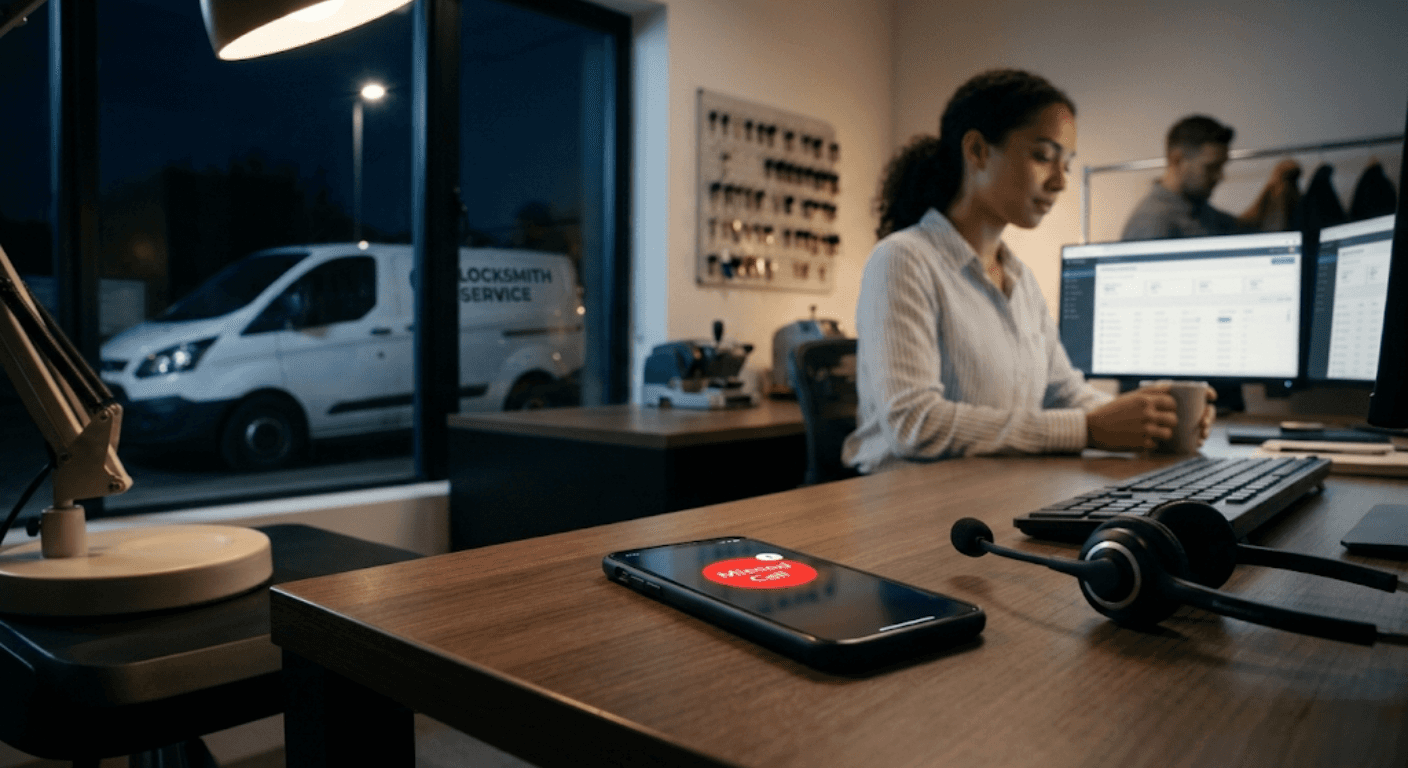
Every missed call is a missed job.
Our human dispatchers answer for you around the clock.
The 62% Problem: When Your Phone Rings and Nobody Answers
Small businesses answer only 37.8% of incoming calls. The remaining 62.2% go to voicemail or receive no response at all. For most industries, that statistic represents an operational inconvenience. For locksmith companies — where 67% of all calls occur outside traditional business hours and every unanswered ring represents a customer in a genuine emergency — it represents a structural revenue leak that compounds daily.[1][2]
Research from multiple industry sources converges on a stark finding: 85% of callers who do not reach a live person never call back, and 62% contact a competitor instead. In a $3.0 billion U.S. locksmith industry composed of 29,620 highly fragmented businesses, the difference between answering and missing a single emergency call is not measured in inconvenience. It is measured in hundreds of dollars of immediate revenue, thousands in lifetime customer value, and permanent market share erosion.[3][4][2]
This article examines the research behind missed-call economics, after-hours demand patterns specific to the locksmith industry, and the evidence-based case for structured human dispatch — drawing from consumer behavior data, emergency service market analysis, FTC consumer protection findings, and locksmith-specific operational research.
Section 1: The Economics of Missed Calls for Service Businesses
What a Single Missed Call Actually Costs
The cost of a missed call extends far beyond the immediate lost transaction. According to an industry cost analysis by Ambs Call Center, the average cost of a single missed call across service industries is $12.15 — but that figure represents a floor, not a ceiling. For home service companies specifically, each missed call carries an average opportunity cost of $1,200 when factoring in job value, follow-up potential, and referral multiplication.[4][5]
Average SMB annual revenue loss from missed calls: $126,000[2][4]
Businesses missing just 2 calls per day lose over $8,800 annually[5]
Businesses missing 6 calls per day lose over $26,000 annually[5]
85% of callers who reach voicemail never call back[4]
62% of unanswered callers switch to a competitor[4]
For a typical SMB missing 50 calls monthly at $500 average service value, the calculation follows a documented formula: 50 × $500 × 12 months × 0.85 (non-callback rate) = $255,000 in annual lost revenue. Even conservative adjustments to this model — lower call volume, lower average ticket — still yield five-figure annual losses for most service businesses.[4]
Why This Hits Emergency-Based Services Hardest
Locksmithing operates in a category that research identifies as uniquely vulnerable to missed-call economics: emergency-based, time-sensitive service businesses. Unlike scheduled service appointments (HVAC maintenance, routine plumbing), locksmith calls are overwhelmingly distress-driven. A customer locked out at 11 PM is not submitting a web form and waiting 24 hours for a callback. They are calling the next number in their search results within seconds of reaching voicemail.[4]
According to customer service research, 67% of callers hang up entirely when they reach voicemail, and 80% will call a competitor rather than wait for a callback. In the locksmith industry specifically, every missed emergency call represents an immediate revenue loss of $150–$400, with the actual cost extending into lifetime customer value when factoring in repeat business.[6][7]
Research from field service analysis shows that locksmith businesses lose 30–40% of potential emergency call revenue due to operational inefficiencies — primarily missed calls, delayed responses, and poor dispatch coordination. For a locksmith operation generating $800,000 in annual revenue (near the industry average of $0.8 million per location), that translates to $240,000–$320,000 in recoverable revenue left on the table annually.[6]
||| For locksmith operators losing 30–40% of emergency call revenue to voicemail and missed connections, the math is unambiguous: a structured human answering layer pays for itself within weeks. Explore how KeyDispatchers structures 24/7 human-only call coverage for locksmith SMBs → keydispatchers.com |||
Section 2: After-Hours Demand — The 67% Insight
When Locksmith Customers Actually Call
The single most consequential data point for locksmith business operations is the timing distribution of inbound calls. Research from emergency service providers reveals that 67% of all locksmith calls occur outside traditional 9-to-5 business hours — encompassing evenings, nights, weekends, and holidays.[1]
This is not a marginal after-hours trickle. It is the majority of total demand.
67% of locksmith calls come outside business hours[1]
Peak call window: 6 PM to 11 PM, accounting for approximately 35% of all daily inquiries[1]
Weekend calls generate 40% higher average ticket value than weekday calls[1]
68% of customers who receive excellent emergency service become repeat clients for non-emergency work[6]
The demand pattern is logical. Lockouts happen when people return home from work, lose keys during evening activities, or discover security issues during off-hours. The 6 PM to 11 PM window alone — a five-hour period when most locksmith businesses have stopped answering phones — accounts for over a third of all daily inquiry volume.[1]
The Premium Revenue Window
After-hours and weekend calls are not only more frequent — they are more valuable. ALOA member surveys indicate that weekend emergency calls average 40% higher revenue than weekday calls, reflecting the urgency premium that customers are willing to pay for immediate service. Emergency lockout pricing ranges from $150 to $400 per service call, with after-hours automotive emergencies and commercial lockouts frequently exceeding $400.[7][6][1]
This creates a paradox: the most profitable hours for locksmith businesses are precisely the hours when most locksmith businesses are not answering their phones.
A simplified revenue model illustrates the scale:
If a locksmith misses 5 after-hours calls per week:
Average after-hours emergency call value: $250
Weekly lost revenue: $1,250
Monthly lost revenue: $5,000
Annual lost revenue: $60,000
Adjusted for 85% non-callback rate: $51,000 in permanently lost revenue
If a locksmith captures those same 5 calls with live answering:
At a 40% phone-to-booking conversion rate (consistent with industry data showing 40% of consumers who call from search end up purchasing)[6]
2 additional booked jobs per week × $250 = $500/week incremental revenue
Annual incremental revenue: $26,000
Plus: 68% of those customers become repeat clients, generating additional downstream revenue[6]
The emergency locksmith service market itself is projected at $6.55 billion in 2025, growing at a 9.03% CAGR through 2033, driven by rising security concerns, smart lock adoption, and increasing consumer demand for 24/7 availability. Locksmiths who do not participate in the after-hours market are excluding themselves from the fastest-growing segment of their own industry.[8][9]
Section 3: The Phone Call Advantage — Why Calls Convert and Web Leads Don't
Phone Calls vs. Digital Leads
In an industry where urgency drives purchasing behavior, the medium of first contact matters enormously. Research compiled across home service industries reveals a conversion gap that should shape every locksmith's lead capture strategy:
Lead Channel
Conversion Metric
Research Finding
Phone calls vs. web leads
Revenue generation
Phone calls convert 10–15x more revenue than web leads[6]
Phone call speed
Conversion velocity
Callers convert 30% faster than web leads[6]
Search-to-call conversion
Purchase rate
40% of consumers who call a locksmith from search results end up purchasing[6]
Mobile search behavior
Purchase timeline
78% of mobile local searches lead to a purchase within 24 hours[6]
Mobile locksmith searches
Device preference
64% of users search for locksmith services on mobile devices[6]
The data reveals a clear hierarchy: for locksmith businesses, a ringing phone is the single highest-value lead event in the entire marketing funnel. Every dollar spent on Google Ads, local SEO, and Google Business Profile optimization is ultimately designed to generate one outcome — a phone call. Locksmith PPC ads carry a conversion rate of 10.22%, significantly above industry averages, specifically because locksmith searches are high-intent and urgency-driven.[6]
When that phone call goes to voicemail, the entire acquisition cost is wasted. At an average cost per lead of $66.02 in locksmith marketing, every missed call represents not just lost revenue but burned marketing spend.[6]
The Compounding Effect
The damage from missed calls is not linear — it compounds. Each lost customer represents:
Immediate revenue loss: $150–$400 per emergency call[7][6]
Lifetime value loss: A single locksmith customer's lifetime value ranges from $5,000 to $15,000 when including repeat service, referrals, and upselling opportunities[4]
Referral multiplication loss: Each lost customer typically refers 2–3 additional prospects who are also lost[4]
Reputation erosion: Customers who cannot reach a business leave negative reviews, which compounds given that 86% of consumers read online reviews before calling a locksmith and 57% only consider businesses with 4+ stars[6]
||| When 64% of locksmith searches happen on mobile and every phone call converts at 10–15x the rate of web leads, the business case for live human answering is not theoretical — it is arithmetic. Learn how KeyDispatchers converts inbound calls into dispatched jobs for locksmith companies → keydispatchers.com |||
Section 4: The Trust Problem — FTC Warnings and the Legitimacy Premium
The FTC Consumer Protection Landscape
The locksmith industry faces a unique trust deficit that amplifies the importance of professional call handling. The Federal Trade Commission (FTC) has issued direct consumer warnings about locksmith fraud, cautioning that "some locksmiths advertising in your local phone book may not be local at all, and that others may not have professional training".[10]
The FTC's consumer alert specifically highlights a pattern of non-local call centers posing as local locksmith businesses — routing calls to unvetted, untrained operators who employ bait-and-switch pricing tactics. This warning, while originally issued in 2008, has proven prescient: rogue locksmith complaints have increased by 66% since 2021, according to the Master Locksmiths Association's tracking data.[11][10]
The scam pattern is consistent and well-documented:
Bait-and-switch pricing: Quoting $39–$59 on the phone, then charging $200–$600+ upon arrival[12][11]
Non-local operators: National call centers posing as local businesses, dispatching untrained contractors[10]
No credentials: Operating without licensing, insurance, or professional certification[10]
Drilling as first resort: Destroying locks unnecessarily to inflate the bill[11]
The Locksmith Ledger's 2025 State of the Industry coverage confirms this dynamic remains active, with industry leaders noting that "the locksmith industry is under assault from Google, and they are taking down ads or they're taking listings down left and right over tiny infractions because of the problems with the scammers". Legitimate locksmith businesses are bearing the reputational cost of fraudulent operators, making professional credibility not just a differentiator but a survival requirement.[6]
The Legitimacy Premium in Call Handling
This trust environment creates a direct strategic advantage for locksmith businesses that answer calls with trained, professional human dispatchers rather than automated systems or voicemail. When a panicked customer calls at 2 AM after being locked out, the first interaction defines their perception of the entire business.
Research shows that 86% of consumers read online reviews before calling a locksmith, and 57% choose businesses rated 4 stars or higher. A professional, empathetic human voice on the first call — one that can confirm credentials, provide transparent pricing, and dispatch a verified local technician — directly addresses the trust gap that the FTC warns consumers about.[6]
Only 15 states currently require formal locksmith licensing, while 35 states have no state-level licensing requirements. In this regulatory vacuum, professional call handling becomes one of the few tangible signals of legitimacy that consumers can evaluate before a technician arrives. The difference between a scripted call center and a knowledgeable human dispatcher who understands locksmith service categories, can verify technician credentials, and can set accurate expectations is the difference between winning and losing a trust-sensitive customer.[6]
Section 5: AI vs. Human Dispatch — What the Evidence Shows
The Comparative Framework
The question of automated versus human call handling has become increasingly relevant as AI answering services enter the locksmith market. The evidence supports a nuanced comparison:
Factor
AI/Automated Dispatch
Human-Only Dispatch
Research Insight
Answer speed
2–3 seconds
10–20 seconds
AI is faster on initial pickup[13]
After-hours availability
24/7
24/7 (when staffed)
Both models can cover all hours
Emergency empathy
Scripted responses
Adaptive, emotionally responsive
Distressed callers need human reassurance — lockouts involve fear, frustration, vulnerability
Consumers seeking locksmiths are already primed to distrust automated systems
Price transparency
Can quote from preset menus
Can explain, contextualize, handle objections
40% higher ticket value on complex calls requires human nuance[1]
Conversion rate
Lower for high-anxiety service calls
Higher — callers convert 30% faster with human interaction[6]
Emergency service callers need confidence, not menus
For routine, high-volume, low-complexity calls, AI systems offer efficiency advantages. But locksmith emergency calls are neither routine nor low-complexity. A parent locked out with a child in a car, a business owner facing a security breach, or a homeowner locked out in freezing weather at midnight requires a response that AI cannot yet replicate: genuine human judgment, emotional calibration, and adaptive communication.
The Trust Compound Effect
In an industry where the FTC has explicitly warned consumers about fraudulent call centers, and where rogue locksmith complaints have risen 66%, the presence of a knowledgeable human voice carries a compounding trust premium. The consumer who reaches a professional dispatcher who can explain the service, confirm the technician's credentials, and provide a transparent price estimate is exponentially more likely to convert — and to leave a positive review that drives future business.[11][10]
The data supports this: 70% of customers are likely to leave a positive review when asked, and each positive review contributes to the 86% of consumers who read reviews before selecting a locksmith. Professional human dispatch creates a virtuous cycle: better first-call experience → higher conversion → better reviews → more inbound calls → more revenue.[6]
||| In a market where consumer trust is fragile and 66% of rogue locksmith complaints stem from impersonal call center operations, human-only dispatch is not a luxury — it is a competitive moat. Discover how KeyDispatchers' trained dispatchers handle emergency locksmith calls with the professionalism your brand requires → keydispatchers.com |||
Section 6: Economic Impact for East Coast Locksmith SMBs
Regional Demand Amplification
East Coast locksmith markets — KeyDispatchers' primary service geography — face amplified versions of every dynamic discussed above. Bureau of Labor Statistics data shows East Coast locksmith wage premiums of 17%–47% above the national median, reflecting both higher operating costs and higher customer willingness to pay for professional service.[3]
Metro areas like Washington, D.C. ($34.19/hour mean wage), Boston ($30.13/hour), and New York-Newark ($28.67/hour) represent dense, high-demand markets where:
Population density increases lockout frequency per square mile
Higher cost of living correlates with higher average ticket values
Competition is intense — 29,620 businesses nationally, with significant concentration in East Coast metros[3]
For an East Coast locksmith operation generating $800,000 in annual revenue (the industry per-location average), the research-supported revenue recovery opportunity from implementing structured 24/7 human answering is substantial:[6]
Missed call recovery: Capturing even 50% of currently missed after-hours calls at $250 average value = $26,000–$52,000 annually
Conversion rate improvement: Moving from 37.8% call answer rate to 95%+ with human dispatch — a 2.5x increase in answered calls[2]
Repeat business capture: 68% of emergency customers become repeat clients, generating an additional 1.5–2x lifetime multiplier on each captured call[6]
Marketing ROI protection: At $66.02 per lead acquisition cost, every answered call protects the marketing investment that generated the ring[6]
The emergency locksmith service market is growing at 9.03% annually, substantially outpacing the broader locksmith industry's flat-to-declining trajectory. The businesses capturing this growth are the ones answering the phone when it rings — not the ones discovering missed calls the next morning.[8][3]
Conclusion: The Evidence Points to One Number
The research across consumer behavior, emergency service economics, FTC consumer protection, and locksmith-specific operational data converges on a single insight: for emergency-based locksmith SMBs, the phone call is the business.
The problem: SMBs answer only 37.8% of incoming calls, and 67% of locksmith calls come outside business hours — meaning the majority of the highest-value leads are going to voicemail[2][1]
The economic consequence: Each missed emergency call costs $150–$400 immediately, with lifetime value losses reaching $5,000–$15,000 per customer when factoring in repeat business and referrals[4][6]
The trust imperative: In an industry where the FTC warns consumers about fraudulent operators and rogue complaints have risen 66%, professional human call handling is not an expense — it is a credibility signal that directly drives conversion[10][11]
The strategic opportunity: Locksmith businesses that implement structured 24/7 human dispatch capture the 67% of demand that occurs after hours, protect their marketing investment, and build the review-driven reputation that 86% of consumers evaluate before calling[1][6]
For emergency-based locksmith businesses — particularly those operating in competitive East Coast markets — the question is not whether to invest in professional call answering. The question is how many thousands in recoverable revenue are being lost each month while the phone rings unanswered.
||| KeyDispatchers provides human-only answering and dispatch built exclusively for SMB locksmith companies. No AI. No voicemail. No missed revenue. Every emergency call answered by a trained human dispatcher who understands locksmith operations, can triage service requests, and dispatch your technicians with the professionalism your customers expect. See the coverage model → keydispatchers.com |||
Sources cited in this article include: Bureau of Labor Statistics Occupational Employment and Wage Estimates (May 2023), IBISWorld U.S. Locksmiths Industry Report (2026), Locksmith Ledger 2025 State of the Industry Report, AIRA Missed Business Calls Statistics (2026), Dialora SMB Revenue Loss Analysis (2025), Ambs Call Center Missed Call Cost Report (2025), AgentZap Locksmith Phone Statistics (2025), Market Report Analytics Emergency Locksmith Service Market Analysis (2025), Federal Trade Commission Consumer Alert on Locksmith Services, Master Locksmiths Association Rogue Locksmith Complaint Data, and Amra & Elma Locksmith Marketing Statistics (2025).